
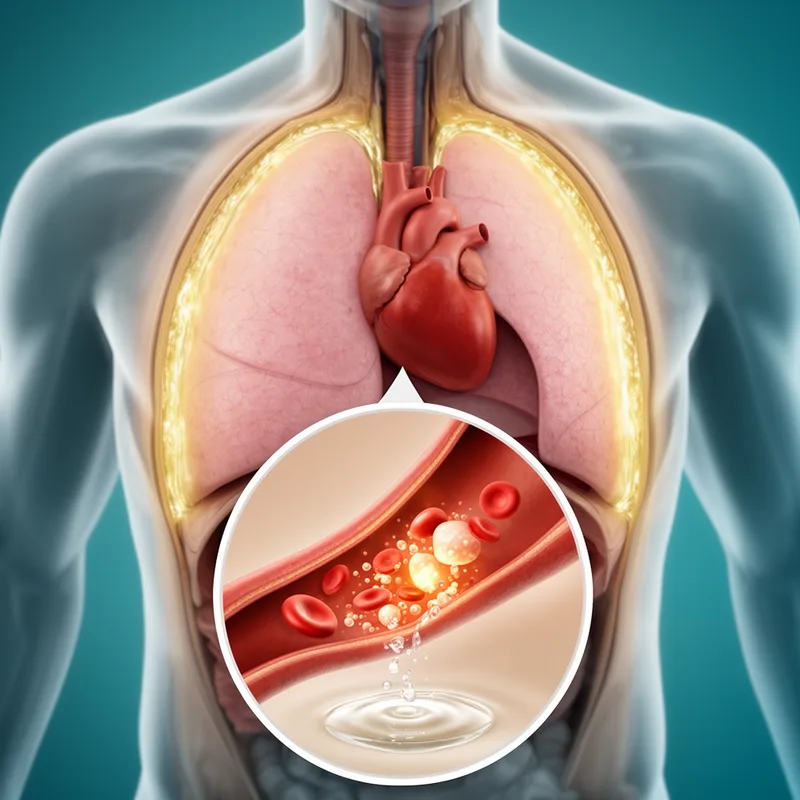
transudative


 1
9.8
- adjective
- /trænˈsjuːdeɪtɪv/
- Specialized
- To diagnose the condition accurately, the health team examined the transudative fluid collected from the patient's lungs.
- transudative effusion
- transudative pleural effusion
Examples
-
Placing an intercostal tube for a transudative pleural effusion is not a safe procedure.
Academic text (2007) -
Detailed evaluation to decipher the cause of transudative effusion pointed to underlying cirrhosis of the liver.
Academic text (2007) -
The cause of this transudative pleural effusion was investigated.
Academic text (2007) -
The presence of a transudative pleural effusion in the absence of significant ascites suggested the existence of a pleuro-peritoneal communication.
Academic text (2007) -
The doctor explained that the fluid was transudative, indicating that it resulted from systemic issues rather than localized inflammation.
-
In patients with heart failure, it is common to observe a transudative pleural effusion due to increased pressure in the blood vessels.
Surface Forms
Morphology
transudative = transudate (transparent) = transudate + ive
The adjective is formed by the regular suffix '-ive' from the noun 'transudate', so the relation is a standard and predictable noun→adjective derivation.
Etymology
Transudative comes from the Latin parts trans- 'across', as in transfer, and sudare 'to sweat', so it literally means a fluid that 'sweats across' a membrane. That's why a transudative fluid is a clear fluid low in protein that passes through membranes because of problems in the whole body, not by a local injury or infection.