
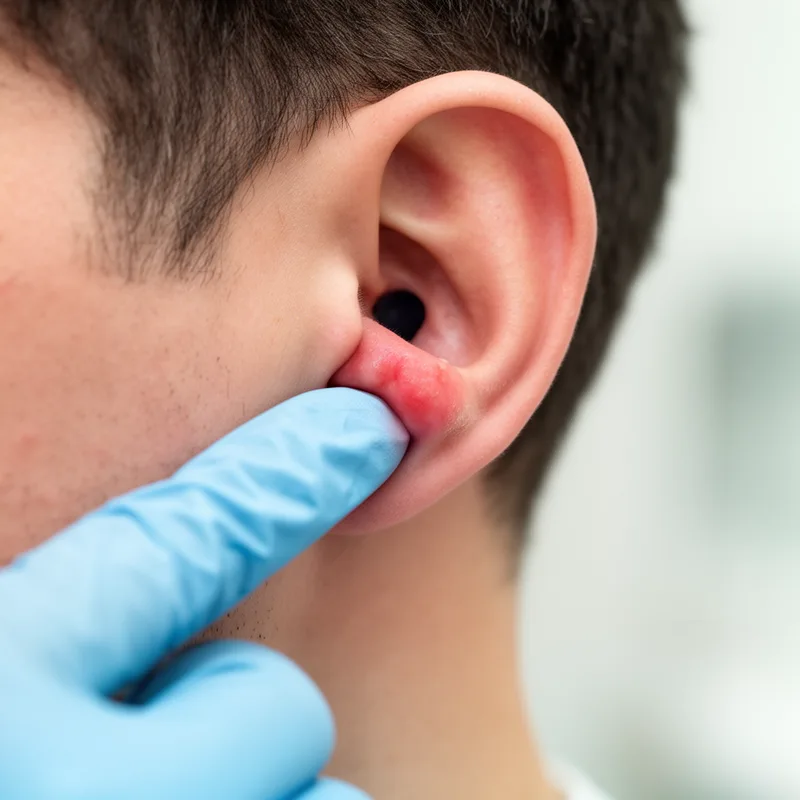
tragal
- adjective
- /ˈtræɡəl/
- Specialized
- Surgeons often use tragal cartilage for reconstructive ear surgeries to create a natural shape.
- tragal cartilage
Examples
-
Tragal cartilage is described as a good alternative in children and adolescents, as it spares disruption of growth centers of the posterior septum and also saves tissue in case further reconstruction is warranted.
Academic text (2009) -
Cartilage, usually tragal cartilage, is liberally employed as an adjunct to fascia tympanoplasty, regardless of whether there is a bony defect.
Academic text (2001) -
Primary care physicians must learn to swab ears and perform tragal pumping.
Academic text (2005) -
Other techniques have been described, from the use of tragal cartilage to composite allo-implants.
Academic text (2009) -
Figure 4: A: The round window niche is occluded with tragal cartilage (arrow).
Academic text (2009) -
Skin is undermined anterior to the vestigial cartilage to accommodate the tragal element of the framework.
Academic text (2014) -
We lightly circumcise the edge of the perforation, and we place an inlay tragal cartilage graft.
Academic text (2006) -
A small piece of tragal cartilage and perichondrium was harvested through an incision on the medial aspect of the tragus.
Academic text (2009) -
During the operation, the doctor mentioned that they would take a sample of tragal cartilage from the patient's ear.
-
The use of tragal grafts has been successful in repairing eardrum perforations.
Surface Forms
Morphology
Etymology
Tragal comes from the medical word tragus, the small piece of cartilage at the front of the ear canal, and tragus comes from the old Greek tragos, which means 'goat' because a little tuft there looked like a goat's beard. So tragal means 'relating to the tragus', which explains why it is used for that small part of the ear.

