
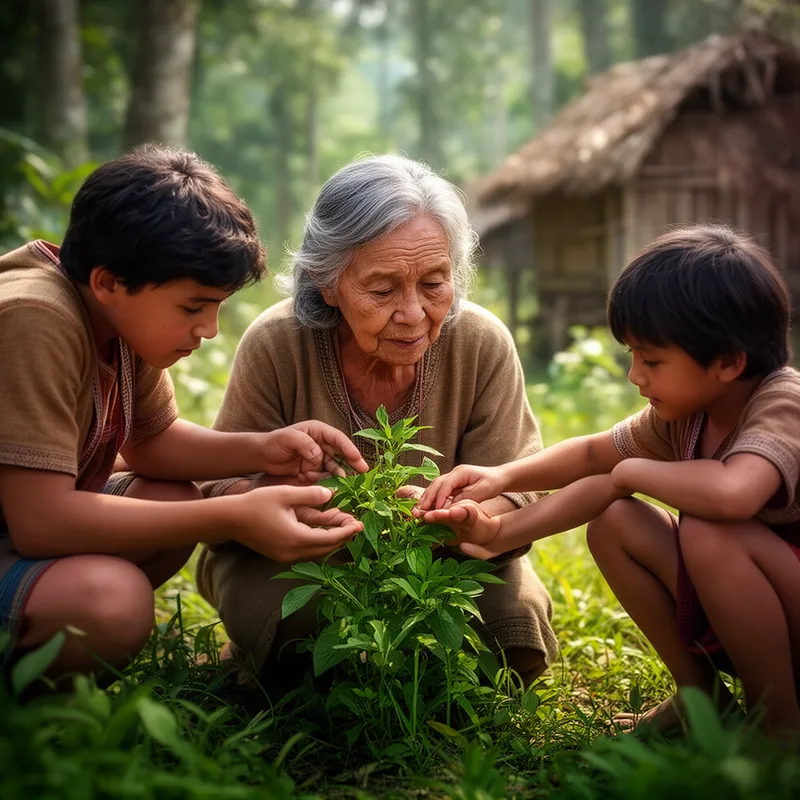
traditional knowledge


 1
4.9
1
4.9
- noun
- /trəˈdɪʃənl ˈnɑːlɪdʒ/
- Specialized
- Elders play an important role in teaching traditional knowledge.
- Indigenous traditional knowledge
- traditional knowledge and practices
- traditional knowledge and cultural
Examples
-
The community works to preserve their traditional knowledge about local plants and their uses in medicine.
-
In many instances, this work has been informed by Indigenous traditional knowledge, which has proved especially useful in reconstructing past cultural landscapes.
Academic text (2005) -
We want our own traditional knowledge and that of Western science to work together.
Academic text (1999) -
Teachers can play an important role in the preservation of traditional knowledge.
Academic text (1995) -
Capturing a single aspect of traditional knowledge is difficult.
Academic text (2004) -
Many acknowledge that wisdom comes not just from school books but also from traditional knowledge and customs, such as folk tales.
Academic text (1995) -
First Nations elders who still occupy the land have a vast store of traditional knowledge about their ancestors' relationship with the local ecology.
Academic text (2011) -
Elders play an important role in teaching traditional knowledge to younger generations.
-
Many acknowledge that wisdom comes not just from school books but also from traditional knowledge passed down through stories.
Synonyms
 ∞
2.0
∞
2.0
A custom or belief passed down in families and groups over time
 241
4.0
241
4.0
Traditions, beliefs, and customs people pass down in a family or society
 52
6.1
52
6.1
Knowledge and stories that people pass down over generations
 43
4.9
43
4.9
Traditional stories, customs, and beliefs people pass down through generations
 1
4.2
1
4.2
Stories and beliefs people tell in a particular town or region
Antonyms


How Traditional

- Specialized
1
4.9
Surface Forms
Morphology
The phrase combines 'traditional' (pertaining to customs or beliefs passed down) with 'knowledge' (information or understanding), so a B1 learner who knows both words can readily infer it means knowledge rooted in tradition or passed down in a community. While the term has specialized legal and policy implications (e.g., rights, consent, benefit‑sharing), those are pragmatic extensions that do not obscure the basic compositional meaning.
Etymology
Traditional knowledge comes from the simple image of elders teaching younger people. Traditional means ways done for a long time and knowledge means what people know, so the phrase pictures skills, stories, and tricks passed down through families and communities.