
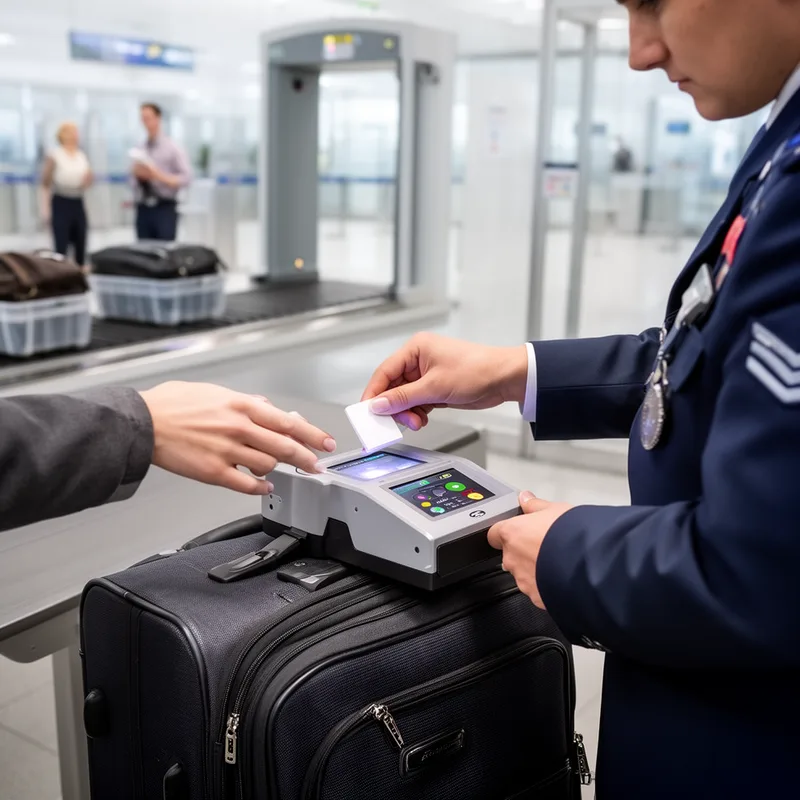
trace detector
- noun
- /treɪs dɪˈtɛktər/
- Specialized
- The airport security officer used a trace detector to check passengers' luggage for any residues of explosives.
Examples
-
The security team relied on a trace detector to screen passengers' carry-on bags for any explosive residues.
-
The trace detector identified traces of explosives.
-
A trace detector can provide results within seconds, making it ideal for busy security checkpoints.
-
Modern trace detectors are highly sensitive and can analyze even tiny amounts of chemical substances.
-
Airport security uses a trace detector for safety.
-
At the airport, a trace detector quickly analyzed samples taken from luggage to ensure safety.
-
Using a trace detector, the officer swiftly identified small amounts of explosive material during the security check.
Synonyms

 189
3.5
189
3.5

A device that senses things like metal, movement, or radioactivity
A machine that finds small amounts of explosives on bags or surfaces

A way to find tiny amounts of explosives on bags using a cloth and a machine

A machine that uses X-rays and computers to find plastic explosives in luggage, often at airports
How Sensitive
- Specialized
13
7.2

- Specialized
- Specialized
13
4.2
898
3.4
- Specialized
189
3.5
Surface Forms
Morphology
The meaning 'a device that identifies very small amounts of substances' follows directly from combining 'trace' (a small sign or amount) with 'detector' (an instrument that detects), so a learner who knows both words can readily infer the MWE. This noun–noun compositional pattern is common and cross-linguistically familiar, making the expression transparent to B1 learners.
Etymology
Trace detector gets its name from the image of finding tiny clues: a trace is a small sign, like a grain of powder, and a detector is something that 'finds' it. So the name fits a device used to quickly find very small amounts of explosives at airports.