
topologically


 1
9.9
- adverb
- /ˌtɑːpəˈlɒdʒɪkli/
- Specialized
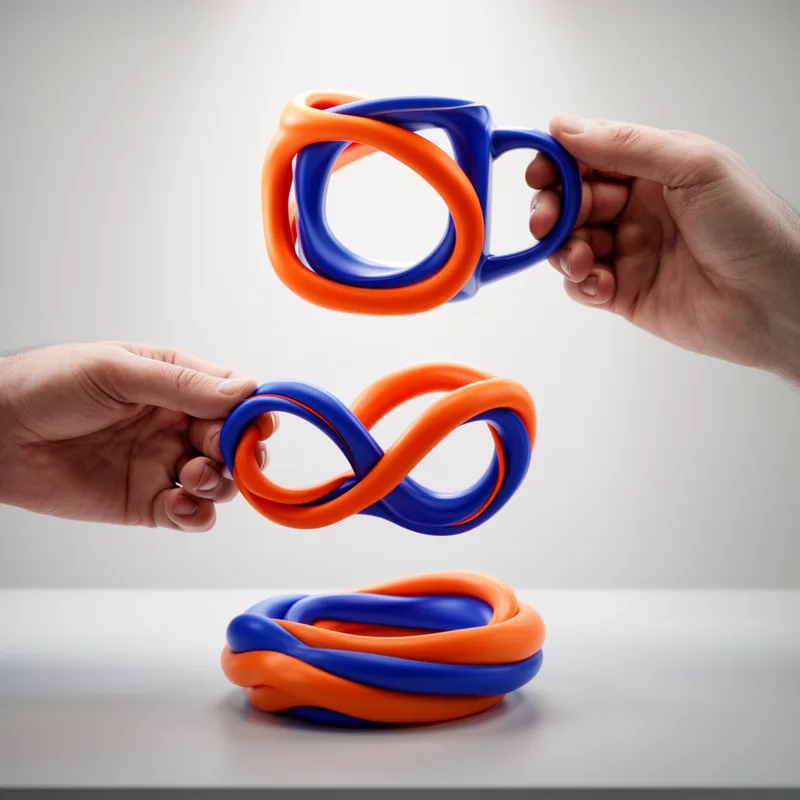
- These shapes may look different, but topologically, they share the same properties of connectivity and continuity.
Loading YouTube…
Watch on YouTubeThese are things that are topologically the same but are smoothly different.
- These are things that are topologically the same but are smoothly different.
- You could think of having describing a Taurus, at least topologically.
Examples
-
Topologically speaking, of course, this is impossible.
Academic text (2000) -
These are things that are topologically the same but are smoothly different.
-
I mean, just topologically it has the properties of a piece of a cylinder.
-
A donut and a cup of coffee are topologically equivalent because they describe the same space.
Academic text (2004) -
I mean, like famously, a mug is topologically the same as a doughnut.
-
Two geometric braids are topologically equivalent if one can be deformed into the other by motions that keep the two boundary planes fixed.
Academic text (1996) -
Topologically, a donut and a coffee mug are equivalent because they can be transformed into one another without cutting.
-
In topology, a torus and a sphere are considered different, but topologically, a stretched balloon can be seen as a flattened version of a ball.
Surface Forms
Morphology
topologically = topological (transparent) = topology + al + ly
Formed by adding the productive adverbial suffix '-ly' to the adjective 'topological', which itself is a regular adjectival derivative of 'topology', so the formation and meaning are predictable.
Etymology
Topologically comes from topo- meaning 'place' and -logy meaning 'study', the same parts you see in topography. So to look at something topologically is to care about how its parts are arranged or connected in space; for example a coffee mug and a doughnut are the same topologically because each has one hole.