
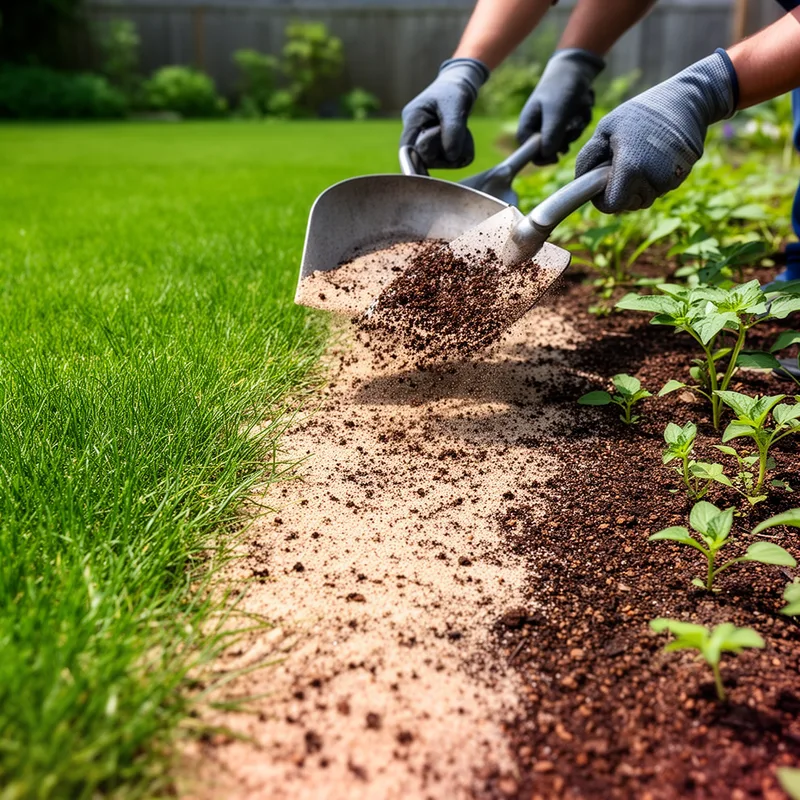
topdressing
- noun
- /ˈtɑpˌdrɛsɪŋ/
- Specialized
- Those advantages enhance the biological, chemical, and physical properties of the root zone, he adds, giving compost strong potential both as a soil amendment and a topdressing.
- compost as a topdressing
- used as a topdressing
Examples
-
In most cases, however, Agresource rents the equipment for one to three days, depending on the acreage needing topdressing.
Academic text (1996) -
For instance, a compost can be finely screened for use as a topdressing.
Academic text (1996) -
Increasing numbers of golf courses are using compost both as topdressing and to build greens.
Academic text (1997) -
We recommend aeration in conjunction with topdressing.
Academic text (1996) -
The first is slated to be used as a topdressing for a road project in the town of Elmore.
Academic text (1999) -
Topdressing is a good method of restoring the "crown" on a football or soccer field, says McNitt.
Academic text (1996) -
PHOTO (BLACK & WHITE): In Massachusetts, Agresource is expanding its customer base by providing topdressing of custom compost blends to athletic fields.
Academic text (1996) -
Had it not been for improved farm technology such as aerial oversowing and topdressing, the reduction of potential pasture productivity on slip-scarred hillslopes during the past century at Wairarapa probably would be as large as 30 percent.
Academic text (1991) -
The faster, better turf recovery from using yard trimmings compost as a topdressing after fairway aerating helped Dinelli overcome his initial doubts about using it for divots.
Academic text (1997) -
A thin layer of topdressing made of sand improved the drainage of the garden soil.
Synonyms
A thin layer of compost or fertilizer spread on top of soil to help plants grow without mixing it in
A light layer of fertilizer or compost spread on soil
How Thick
- Specialized

 4
5.2
4
5.2
 39
2.5
39
2.5
- Specialized
3
4.6
5
4.6
Surface Forms
Morphology
Etymology
Topdressing combines top ('upper part') and dress ('to cover' or 'make ready'), so it means a cover put on the top of soil. That's why gardeners spread a thin layer of compost, sand, or fertilizer over grass or garden beds to improve the surface.