

toga
 22
8.4
22
8.4

- noun
- /ˈtoʊɡə/
- The ancient Romans wore a toga as a symbol of citizenship and status.
- a Roman toga
Loading YouTube…
Watch on YouTubeI mean, I, I like to visualize it as you, you know, Peter Schiff in in a toga walking around the Roman Forum.
- I mean, I, I like to visualize it as you, you know, Peter Schiff in in a toga walking around the Roman Forum.
- They gathered at the Senate on the morning of the Ides with daggers under their togas, daggers on the belts of their tunic.
- Pilot A foxy red toga rocks togs on some curtain for this here theatre of suffering.
Examples
-
Someone behind me threw a luxurious toga over my shoulders.
Fiction book (2000) -
I think of ancient philosophers, people walking around with togas, very much a fan of those people.
-
Well, are you coming to the toga party tonight?
-
That is good to know, I will plan my toga party accordingly.
-
Madam probably has a toga party to go to.
-
My red toga with the acorns.
-
Yes, it's a party with togas!
-
When she saw me standing outside dressed in my toga, her white face paled even more.
Fiction book (2002) -
This would have been a flamboyant purple toga and a crown of Laurel leaves.
-
Tightly wrapped in a dark blue toga, he stepped noiselessly along the flagstones of the Forum.
Fiction book (1991)
Synonyms
 61
3.2
61
3.2
A loose outer coat that fastens at the neck and hangs down the back
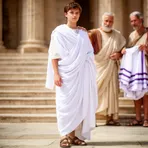
A white robe a Roman young man wore when he became an adult and a citizen
Compounds
- Literature
A white robe a Roman young man wore when he became an adult and a citizen
Surface Forms
Etymology
Toga comes from the Latin word toga, which meant a large wrapped 'cloth' or 'cloak' that Roman men wore to show they were free citizens. So a toga today means that loose, wrapped Roman garment you see at costume parties and in history pictures.