
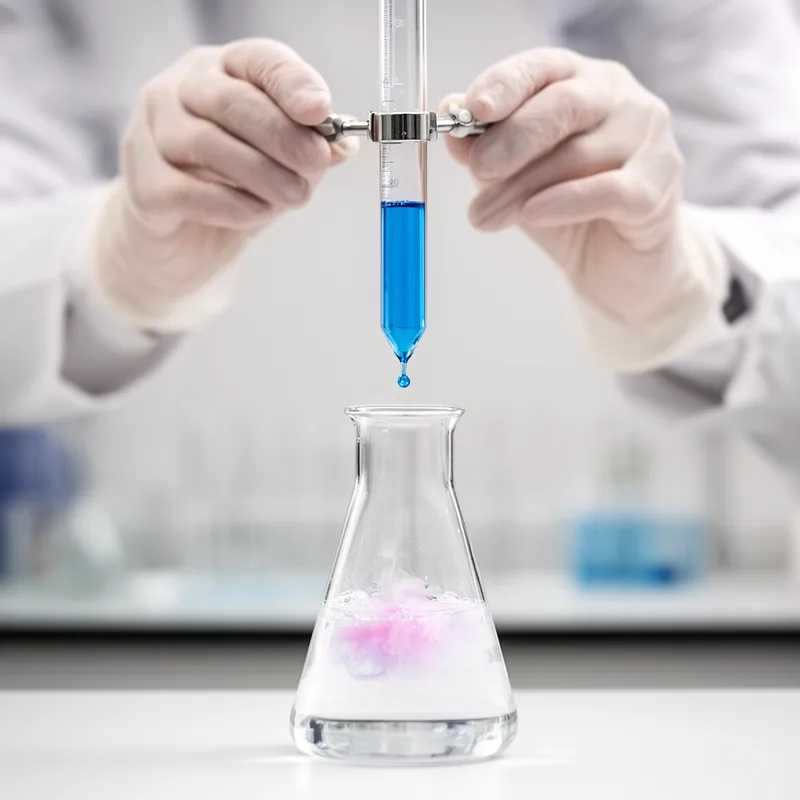
to titrate


 1
8.9
1
8.9
- verb
- /ˈtaɪtreɪt/
- Specialized
- Afterward, the samples were titrated in A. castellannii.
- titrated sample
Examples
-
Each student titrates an acid sample and calculates its concentration.
Academic text (1994) -
Nitrogen released was titrated with NaOH (0.1N). A blank was run along with the sample.
Academic text (2015) -
So now we're talking about a weak acid being titrated with a strong with a strong base.
-
Actions are carefully titrated, reactions calibrated, variables accounted for.
Fiction book (2001) -
He had us suck out gastric juice, titrate the acid, and calculate secretory rates.
Academic text (2001) -
Another option is titrating the amount of tin left in the electrolyte, and assuming that there is a finite amount of tin, it is a very accurate procedure.
Blog text (17) -
Viral load values below the assay-specific lower limit of detection (7% of all measurements) were set equal to this limit; values above the linear dynamic range were rare because of the practice of titrating out samples with high concentrations of virus.
Academic text (2003) -
For each sample, virus was isolated and titrated in eggs in triplicate (3 eggs/sample, 100 L each of 6 serial log10 dilutions) as described (15, 20).
Academic text (2014) -
The viruses were propagated and titrated in specific pathogen-free (SPF) eggs and stored at -70°C until further use.
Academic text (2015) -
In the chemistry lab, the teacher instructed us to titrate the acid solution to determine its exact concentration.
How Precise

Surface Forms
Morphology
Etymology
Titrate comes from the French titre and the Latin titulus, words for a 'title' or label and the same root as the English word title. Chemists used titre to mean the 'strength' written on a bottle, so to titrate is to find a liquid's strength by adding another liquid little by little until the reaction finishes.