
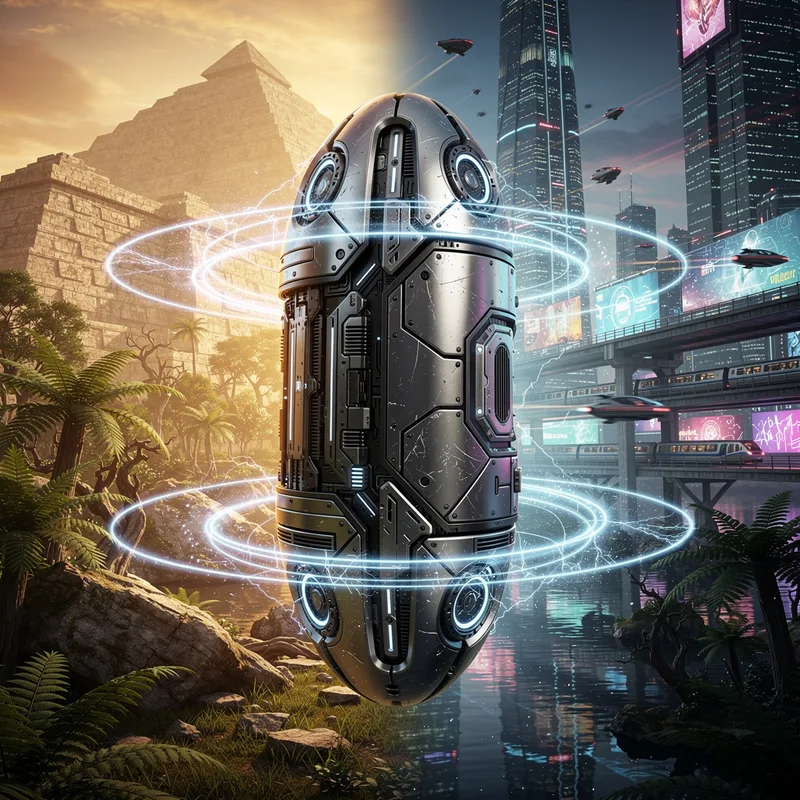
time machine
 30
6.5
30
6.5

- noun
- /taɪm məˈʃin/
- Literature
- Last night he'd wished with all his heart that he could ride in a time machine.
- invent a time machine
Loading YouTube…
Watch on YouTubeAnd so now you are actually entering a time machine basically.
- And so now you are actually entering a time machine basically.
- Is MIT really building a time machine to find dark matter?
- And the How to Build the World's First Time Machine is available on YouTube as well.
- First of all, congratulations on inventing a time machine.
- I had thought I had thought of a time machine that basically ran on all the data based on your brain.
- I feel like I'm in a time machine a lot watching it like it's real, it's accurate, and it's amazing.
- Well, so yeah, if, if, if they were stable or you could stabilize them in some way, then you could use them as time machines.
- No, you need to get back to that time machine where you've ended up.
- But she used to say my time machine's broken.
Examples
-
She dreamed of using a time machine to witness historical events firsthand.
-
You know, if you could travel back and change one thing if you had a time machine, what would that be?
-
You set up a time machine, OK, a time machine watch.
-
Do you have to get in a time machine before you use that?
-
Do you know anybody with a time machine who can spin us all back a year or so?
-
So that could mean that a time machine will never be invented in the future.
-
We have evidence that Dr. Evil has developed a time machine... ...and has traveled back to the year 1969.
-
If someone built a time machine, they'd be famous for all time.
Fiction book (1999) -
Let us end by taking a brief fantasy trip in a time machine to 2030.
Academic text (2006) -
When I was researching my book I kept thinking about this idea of if I was to have a time machine, where and when would I want to be transported back to?
Surface Forms
Morphology
The compound 'time machine' is directly interpretable as a 'machine' that acts on or manipulates 'time', so a learner who knows 'time' and 'machine' can infer it refers to a device related to time (typically for traveling or manipulating time). This compositional pattern is common across languages and in fiction, making the meaning immediately accessible to a B1 learner without prior exposure.
Etymology
The compound noun time machine may come from H. G. Wells's story 'The Time Machine', where a small machine carries a person through time to the past or future. That's why the phrase means 'a device that lets someone go to the past or future'.