
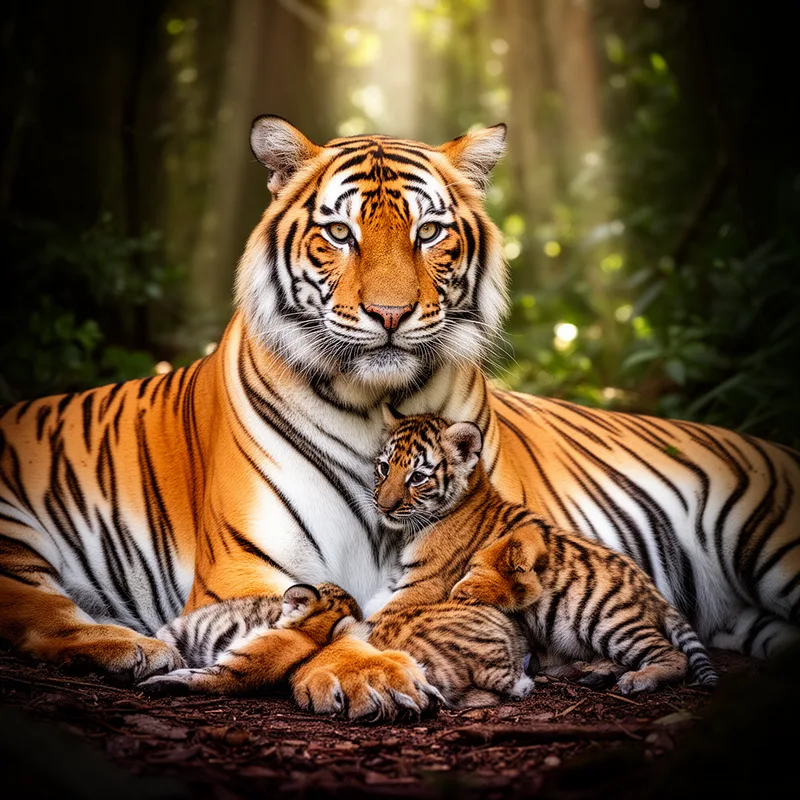
tigress
 5
2.6

- noun
- /ˈtaɪɡrəs/
- Under cover of spruce, pine, and birch, the two tigresses stalked sika deer and other prey.
Examples
-
The tigress had abandoned a three-week-old litter of cubs and wandered into Terney looking for a meal.
Academic text (2010) -
Reclining at the foot of her kill, the tigress gazes unperturbed into the beam of the flashlight.
Academic text (2003) -
What a fierce tigress it is.
-
The tigress's reality is that she has to eat to survive.
Academic text (2003) -
Four days earlier, the tigress had lazed in the sun in front of a camera trap, a research camera designed to record the motions of large wild animals.
Academic text (2011) -
To begin with, the tigress saw the bullock as prey—something to satisfy her hunger.
Academic text (2003) -
Our tigress lives in Kanha National Park, in the forests of Kipling's Jungle Book, where dawn elephant patrols ensure this is one of the safest places for tigers to roam.
-
The tigress is fiercely protective of her cubs.
-
In the wild, a tigress often hunts alone during the night.
-
Wildlife photographers captured stunning images of a tigress prowling through the jungle.
Synonyms
 218
1.0
A large wild cat from Asian forests with orange fur and black stripes, now rare
Surface Forms
Morphology
Etymology
The word tigress is made from tiger + -ess, a word ending that shows 'female' in many English words. Think of actress to remember that -ess marks a woman, so a tigress is simply a female tiger.