
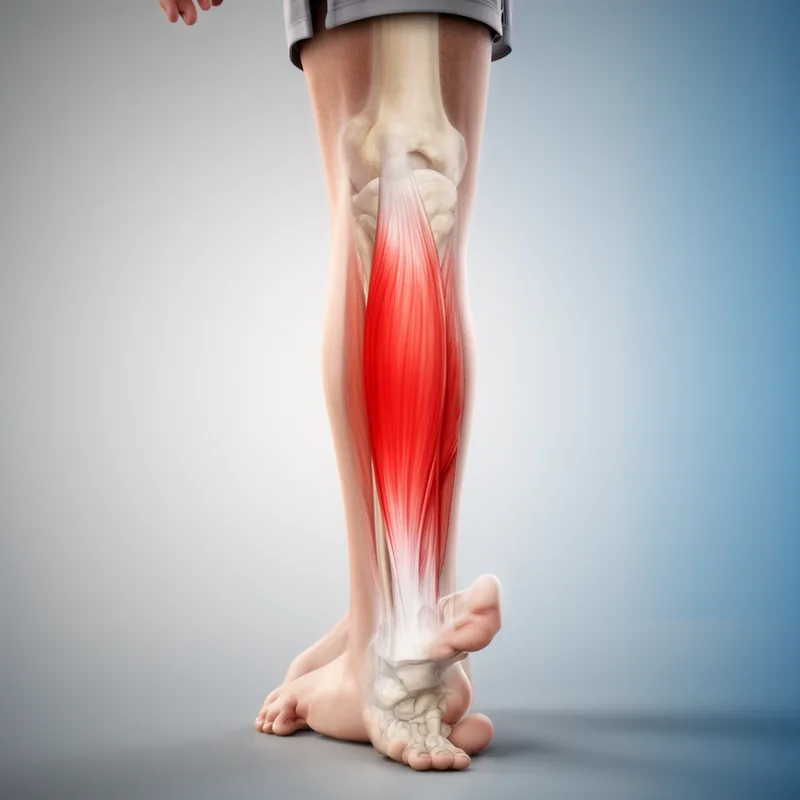
tibialis anterior
- noun
- /ˌtɪbiˈælɪs ænˈtɪəriər/
- Specialized
- The tibialis anterior muscle plays a crucial role in lifting the foot during walking.
- tibialis anterior muscle
- tibialis anterior and gastrocnemius
Examples
-
During the swing, the tibialis anterior muscle assisted dorsiflexion of the foot and prevented a foot splash.
Academic text (2000) -
Surface EMG electrodes were placed over the tibialis anterior and soleus muscles.
Academic text (2001) -
Consequently, the activity of the tibialis anterior muscle was reduced on the gait trainer compared to the treadmill.
Academic text (2000) -
In the other case, spillover to the soleus was combined with inversion and some unspecified action of the tibialis anterior.
Academic text (2001) -
A two-channel EMG amplifier records the surface electromyographic signal over the tibialis anterior and soleus muscles.
Academic text (2001) -
Overall, the median muscle strength in response to FNS was between grades of 2.0 (short head, biceps) and 3.0 (tibialis anterior, peroneals, and quadriceps).
Academic text (2001) -
On the gait trainer, the plantarflexor did not show any spasticity-related activity (it was well modulated instead), and the tibialis anterior was markedly less active.
Academic text (2000) -
Therefore, for the sake of this analysis, we assumed that the tibialis anterior and gastrocnemius were the primary muscles targeted and categorized the synergies as spillover, even though they were desirable.
Academic text (2001) -
Injuries to the tibialis anterior can lead to difficulty in dorsiflexing the foot.
-
Strengthening the tibialis anterior is important for improving balance and stability.
Synonyms

A muscle at the front of the lower leg that lifts the foot and turns the sole inward
Surface Forms
Morphology
The compound is compositionally built from 'tibialis' (a muscle related to the tibia/foot movement) and 'anterior' (toward the front), so a learner who knows both parts can infer it refers to the muscle at the front of the tibia that moves the foot. Anatomical names follow consistent, cross-linguistic Latin-based patterns, making the basic referent transparent even if specialized actions (dorsiflexion/inversion) require technical knowledge.
Etymology
Tibialis anterior comes from two parts: tibialis, named after the 'tibia' or shin bone, and anterior, meaning 'front'. It is the muscle at the front of the lower leg that lifts your foot when you walk, so the name tells you where the muscle is and what it does.

