
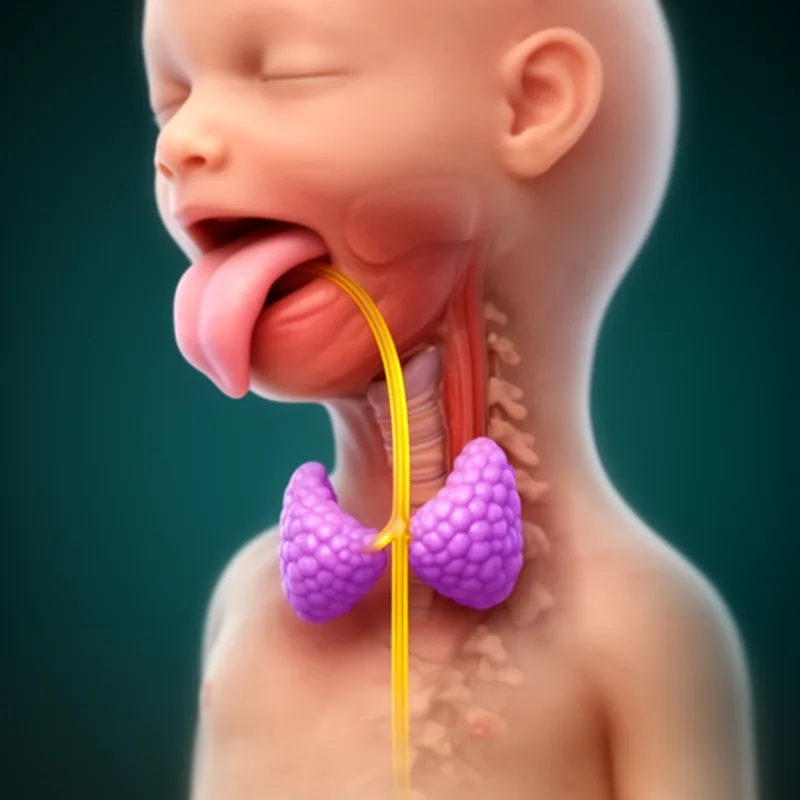
thyroglossal


 1
9.9
- adjective
- /ˌθaɪroʊˈɡlɒsəl/
- Specialized
- Congenital sources of neck masses in children include cystic hygroma, branchial cleft cysts, and thyroglossal duct cysts.
- thyroglossal cyst
- thyroglossal duct
Examples
-
A thyroglossal duct cyst often causes swelling in the midline of the neck.
-
On CT, a thyroglossal cyst usually appears as a smooth, well-circumscribed mass at any point along the course of the thyroglossal duct.
Academic text (2006) -
Approximately 7% of the population has thyroglossal duct remnants.
Academic text (2006) -
As mentioned, 90% of thyroglossal duct cysts lie at or very close to the midline.
Academic text (2006) -
Some 90% of thyroglossal duct cysts lie at or very close to the midline.
Academic text (2006) -
When they do occur, the most common are thyroglossal duct cysts and branchial anomalies.
Academic text (2008) -
In this article, we describe a case of thyroglossal duct cyst that was unusual with respect to its location and its immobility during tongue protrusion.
Academic text (2006) -
On all radiologic images, a thyroglossal duct cyst appears as a cyst-like mass either at the level of the hyoid bone or inside the strap muscles.
Academic text (2006) -
The normal migration of the primitive thyroid from the foramen cecum to its mature position in the anterior neck results in the creation of the thyroglossal duct.
Academic text (2006) -
Detailed histologic examination is essential not only to establish the diagnosis of a thyroglossal cyst, but also to exclude carcinoma. No ectopic thyroid tissue was found in our patient.
Academic text (2006)
Surface Forms
Morphology
thyroglossal = thyro- + glossal (opaque) = thyro + glossal
Formed from specialized Greek combining forms used in medical terminology; the elements are not transparent to an average B1 learner.
Etymology
Thyroglossal combines the parts thyro- from thyroid, meaning 'neck gland', and glossal from glossa, meaning 'tongue', so it refers to the tube or connection between the thyroid and the tongue.