
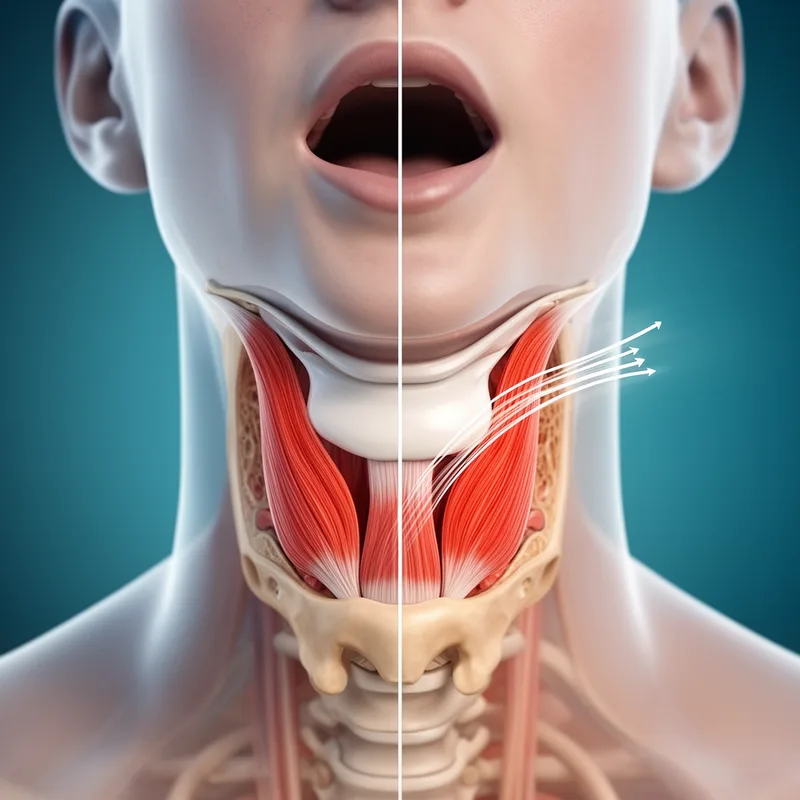
thyroarytenoid
- noun
- /ˌθaɪroʊˈɛrɪtɪnɔɪd/
- Specialized
- The thyroarytenoid muscle plays a crucial role in regulating vocal tension during speech.
- thyroarytenoid muscle
- stimulation of the thyroarytenoid
Examples
-
A number of muscles and ligaments work with the larynx to make sound, but two muscle pairs, the thyroarytenoids and the cricothyroids, are primarily responsible for what we commonly call head voice and chest voice.
Academic text (2005) -
We have demonstrated the potential for rat thyroarytenoid muscle to remodel in response to chronic electrical stimulation.
Academic text (2011) -
Table 1. Comparison of thyroarytenoid muscles in treated and untreated rat larynges.
Academic text (2011) -
Following the training, rats were killed, and thyroarytenoid muscles were isolated for histology and immunohistochemistry.
Academic text (2011) -
Ten m-thick frozen coronal laryngeal sections were used to examine both the left and right thyroarytenoid muscles. The left thyroarytenoid muscle was used as the internal control.
Academic text (2011) -
Ten m-thick frozen coronal laryngeal sections were used to examine both the left and right thyroarytenoid muscles. The left thyroarytenoid muscle was used as the internal control.
Academic text (2011) -
In this study, the authors examined the feasibility of the rat thyroarytenoid muscle to remodel as a consequence of increased activity instantiated through chronic electrical stimulation.
Academic text (2011) -
In fact, a key age-related change in the thyroarytenoid muscle is reduced endurance marked by a slower, weaker, and less fatigue-resistant profile (Thomas, Harrison, & Stemple, 2008).
Academic text (2011) -
The results of our study demonstrate that both 1 and 2 weeks of chronic nerve stimulation significantly alter thyroarytenoid NMJ quantity despite a decrease in fiber size and a change in NMJ density at 1 week of stimulation.
Academic text (2011) -
Findings on laryngeal EMG were essentially normal, except for the detection of a few large-amplitude motor units within the left thyroarytenoid muscle that were not consistent with a focal laryngeal mononeuropathy.
Academic text (2006)
Surface Forms
Morphology
Etymology
Thyroarytenoid is formed from thyro- ('shield') and arytenoid ('little cup'), naming the muscle that runs between those two cartilages in the voice box. So the word helps you remember that this muscle connects the 'shield' and 'little cup' parts and so controls the tension of the vocal cords.

