

three-banded armadillo
- noun
- /θriː ˈbændɪd ˌɑːrməˈdɪloʊ/
 :
armadillo de tres bandas
:
armadillo de tres bandas
- Unlike other species, the three-banded armadillo is able to completely enclose itself using its armored shell.
Examples
-
The three-banded armadillo can curl itself into a tight ball to protect against predators.
-
Researchers found a three-banded armadillo in the grasslands of Brazil during their field study.
-
The three-banded armadillo is a unique species.
-
Did you see the three-banded armadillo at the zoo?
-
Researchers found a three-banded armadillo in the grasslands of Brazil during their field study.
-
The three-banded armadillo can curl itself into a tight ball to protect itself from predators.
-
Did you see the three-banded armadillo at the zoo last weekend?
Synonyms


 1
9.9
1
9.9
A small armadillo with three bands of hard plates that can curl into a ball
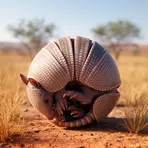
A small South American armadillo with three bands of hard plates that can roll into a ball

A South American armadillo with three bands that can roll into a ball
How Big
- Specialized

- US
Surface Forms
Morphology
three-banded + armadillo
The phrase is compositionally built from 'three' (a number) + 'banded' (having bands) + 'armadillo' (a shelled mammal), so a learner knowing the parts can infer it denotes an armadillo with three bands on its shell. This straightforward numeral+adjective+noun construction follows common cross-linguistic patterns and involves no idiomatic shift, making the meaning directly derivable.
Etymology
Three-banded armadillo comes from the animal's look: it has three movable bands of bony plates on its back and armadillo comes from Spanish meaning 'little armoured one'. Because of these bands it can curl into a tight ball to protect itself, so the name shows its shape and how it defends itself.