
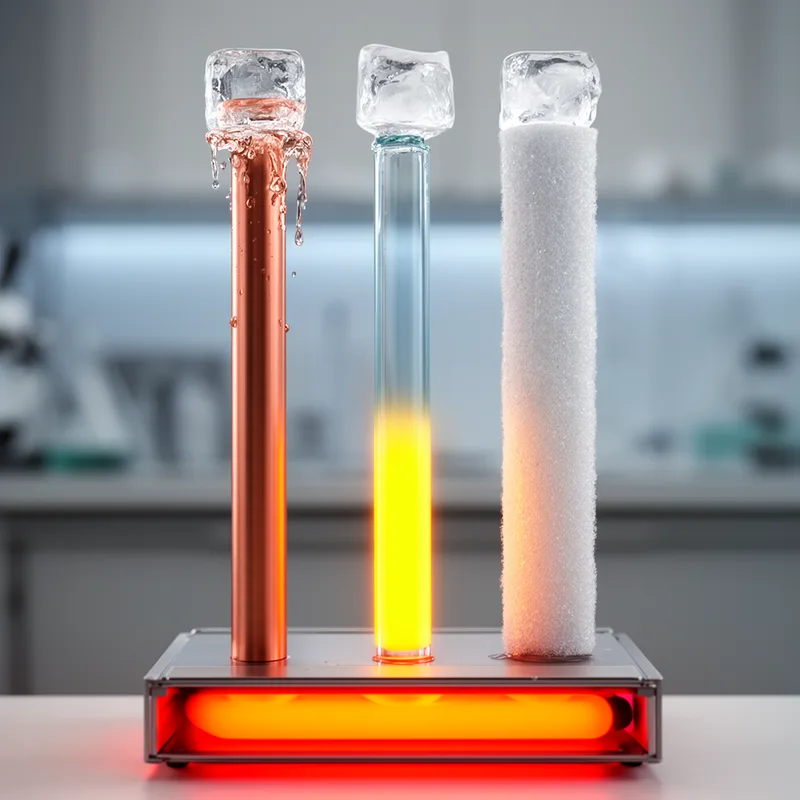
thermal conductivity
 1
4.8
1
4.8

- noun
- /ˈθɜrməl ˌkɒndʌkˈtɪvɪti/
- Specialized
- All the material properties, including density, specific heat, and thermal conductivity, are considered to be functions of the particle concentration.
- high thermal conductivity
- low thermal conductivity
- heat and thermal conductivity
Examples
-
Furthermore, thermal conductivity over the same temperature range varies nearly as the square of the temperature.
Academic text (1998) -
The combination of two qualities—high thermal conductivity and low electron mobility—constitutes a fourth characteristic of in-demand commercial composites.
Academic text (1999) -
And it is called the thermal conductivity of that material.
-
You tend to think this is the thermal conductivity, right?
-
The thermal conductivity is dependent on temperature and there is no real standard for it.
-
Liquids are significantly better heat transfer media than air because their thermal conductivity and thermal capacity are higher.
Academic text (2001) -
Owing to its low thermal conductivity, a blanket of snow slows the growth of underlying ice during the cold season.
Academic text (2011) -
The winding is cast in epoxy resin containing boron nitride to increase its thermal conductivity.
Academic text (1995) -
Properties such as thermal conductivity, electrical conductivity, optical absorption and emission spectra, mechanical strength, and viscosity are size dependent.
Academic text (2004) -
The thermal conductivity of copper makes it an excellent choice for electrical wiring.
Synonyms
 6
4.9
6
4.9
The ability of a material to let heat, electricity or sound pass through it
Antonyms


How Conductive

Surface Forms
Morphology
The meaning is directly and compositionally derived from 'thermal' (related to heat) combined with 'conductivity' (capacity to conduct), so a B1 learner who knows both constituents can infer it. This compound follows regular English compounding patterns and has clear parallels in many languages (e.g., French 'conductivité thermique', Spanish 'conductividad térmica'), reinforcing its transparency.
Etymology
The compound thermal conductivity combines thermal, meaning 'heat', and conductivity, from the verb 'conduct' meaning 'to carry' or 'to lead'. So it simply describes how well a material carries or passes 'heat'.