
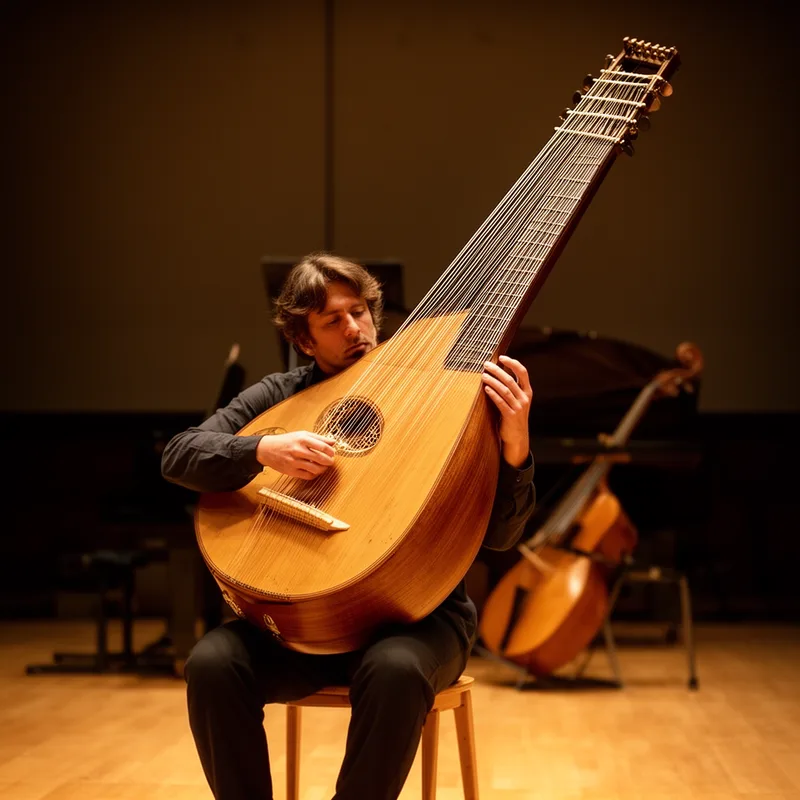
theorbo


 1
9.9
- noun
- /θiˈɔrboʊ/
- Specialized
- The theorbo is often used to provide a rich accompaniment in Baroque music performances.
Examples
-
Huygens's left hand is "below," Susanna's right higher up, just as in their joint music-making he would take the "low" line of the basso continuo (we remember the theorbo in his portrait by De Keyser) while she would sing (or play) the higher melodic lines.
Academic text (1991) -
The notation is rather exceptionally confined to the basso continuo, which was performed on either a theorbo (a bass lute) or a keyboard instrument.
Academic text (1991) -
The work is evidently intended to display Huygens's prominent position at the court at The Hague, while also characterizing him, through the objects on or near a table (among them a theorbo), as a man of intellectual and musical interests.
Academic text (1991) -
During the performance, the musician skillfully played the theorbo, creating beautiful harmonies.
-
He carefully tuned his theorbo before the concert, eager to showcase its unique sound.
How Low

Surface Forms
Etymology
Theorbo comes from the Italian name tiorba (also teorba), which was the name for a 'large lute'. It is in the same family as the familiar lute, so think of a lute with a very long neck and extra low strings — that's why a theorbo gives deep notes and was used to accompany singers and ensembles.