
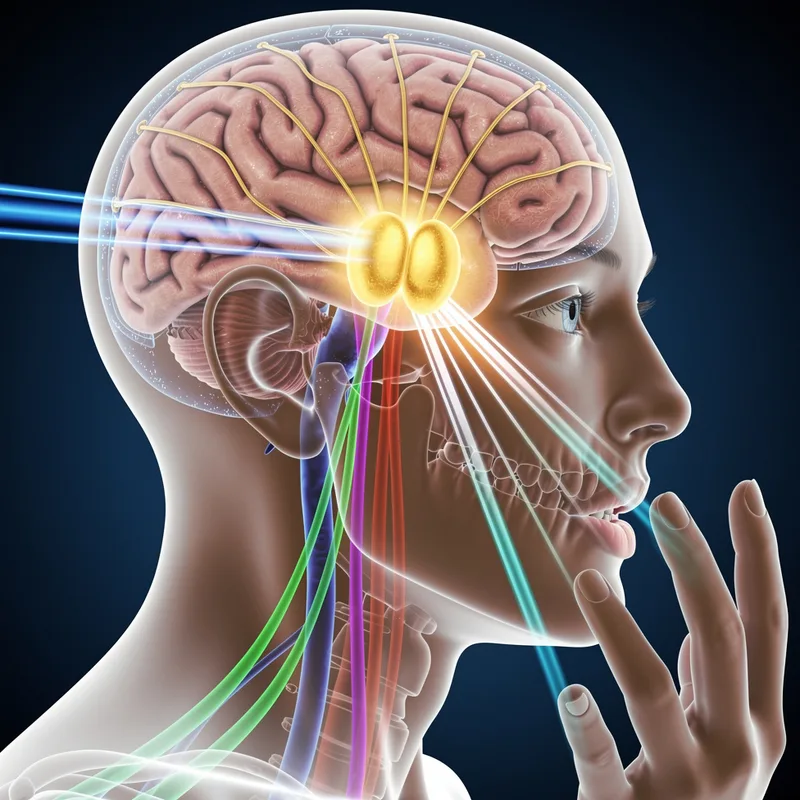
thalamic
 2
8.5

- adjective
- /θəˈlæmɪk/
- Specialized
- Given appropriate environmental conditions, like adequate illumination and normal vision (as established by the retina, optic nerves and tracts, subsequent thalamic and cortical processing), I can successfully answer questions concerning the details of "Peter" (clothing, hair dressing, wearing glasses or not, etc.).
- thalamic and cortical
Loading YouTube…
Watch on YouTubeSo the thalamic reticular nucleus is really saying no, touch information cannot come in right now.
- So the thalamic reticular nucleus is really saying no, touch information cannot come in right now.
- Are are thalamus that thalamic gait becomes less and less aware of the world outside of us?
Examples
-
So the thalamic reticular nucleus is really saying no, touch information cannot come in right now.
-
The most common term you'll find among your anatomist is to call it the spinal thalamic tract.
-
Are are thalamus that thalamic gait becomes less and less aware of the world outside of us?
-
The somatosensory inputs are passing through, so the spinal thalamic crack also goes to detect in there.
-
Pain perception is associated with the right hemisphere, and thalamic pain arises more often with right-sided damage.
Academic text (2001) -
Quite simply, we sever the nerves within the spino-thalamic tract.
-
The BNST acts as a critical node in the brain, receiving inputs from cortical, amygdalar, thalamic, hypothalamic, and brainstem regions (for review see Kash, 2012).
Academic text (2016) -
Abnormality of the middle latency response (8-50 msec) suggests a problem in the primary auditory projection pathway (thalamic region to primary auditory cortex).
Academic text (1995) -
The posterior orienting network, including cortical, midbrain, and thalamic areas, underlies early orienting (Posner & Raichle, 1994).
Academic text (1998) -
The thalamic region of the brain is crucial for processing sensory information from the body.
Surface Forms
Morphology
Etymology
Thalamic comes from the Greek root thalamos, meaning 'inner chamber' or 'room'. So the thalamic part of the brain is like a small inner room that receives and sorts sensory messages before they go to the rest of the brain.