
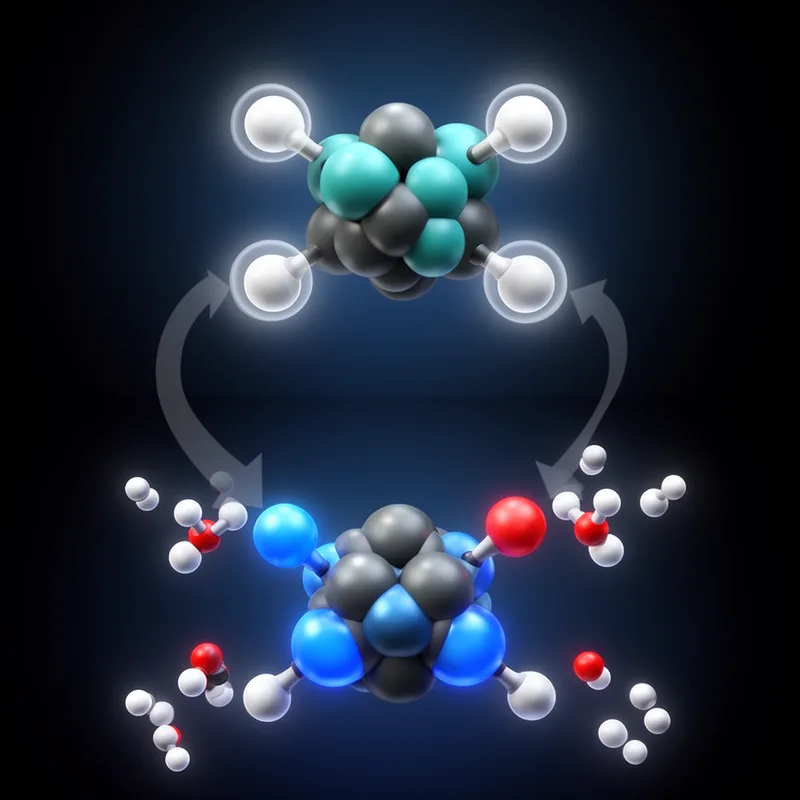
tetrabasic acid
- noun
- /ˌtɛtrəˈbeɪsɪk ˈæsɪd/
- Specialized
- A tetrabasic acid can donate four protons.
Examples
-
Because it contains four replaceable hydrogen atoms, a tetrabasic acid can participate in multiple neutralization reactions.
-
The chemist explained how a tetrabasic acid can form several types of salts.
-
Phosphoric acid can act as a tetrabasic acid under certain conditions.
-
Many tetrabasic acids are used in organic chemistry.
-
In chemistry class, we learned that a tetrabasic acid has four hydrogen atoms that can be replaced to create different salts.
-
The laboratory experiment demonstrated how a tetrabasic acid can react to form a variety of neutral salts.
-
Her research focused on the properties of a tetrabasic acid, which allows it to participate in several chemical reactions.
Synonyms
A solid acid with two phosphorus atoms that scientists use in labs to reduce other chemicals
Surface Forms
Morphology
tetrabasic + acid
The phrase is compositionally adjective + noun and 'tetrabasic' can be parsed as tetra- ('four') + basic, so a learner might infer it relates to 'four' in some chemical sense. However, the precise meaning — an acid able to donate four protons / form four series of salts — requires specific chemistry knowledge and affix parsing beyond B1 learners, so the relation is only partially predictable.
Etymology
Tetrabasic acid comes from tetra- meaning 'four' and basic referring to the number of hydrogen spots that can be replaced. Think of a tiny molecule with four little hydrogen flags that can be taken away to make salts, so the term means an acid with 'replaceable hydrogen atoms' that can form several salts.

