
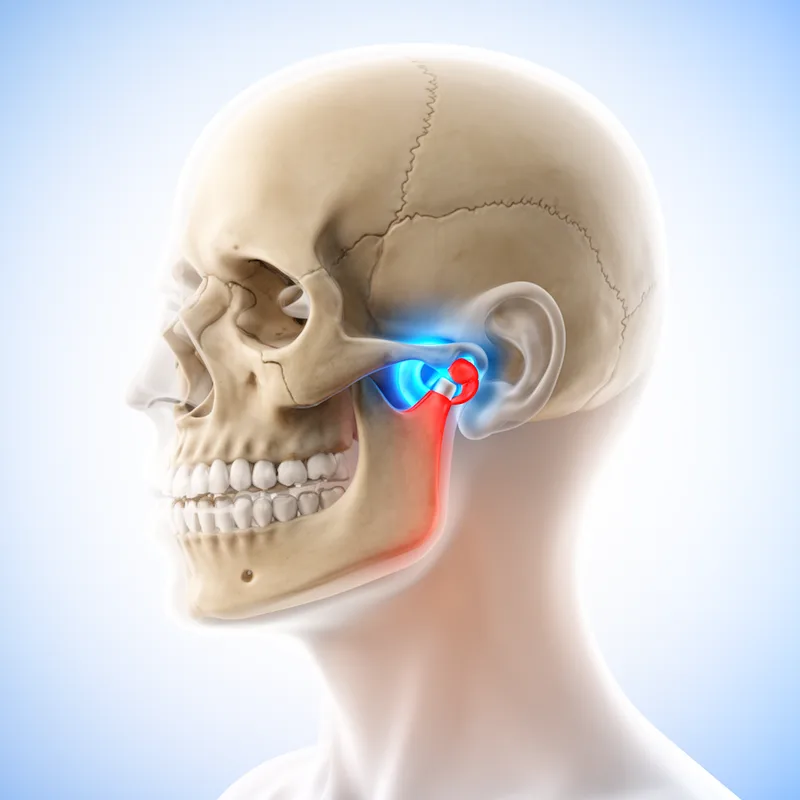
temporomandibular joint
 1
5.5
1
5.5

- noun
- /ˌtɛmpəroʊmænˈdɪbjələr dʒɔɪnt/
- Specialized
- The dentist explained that my temporomandibular joint helps me chew and speak properly.
- temporomandibular joint disorder
- synovitis of the temporomandibular joint
Loading YouTube…
Watch on YouTubeYou can have TMJ syndrome where your temporomandibular joint is inflamed and that leads to tinnitus.
- You can have TMJ syndrome where your temporomandibular joint is inflamed and that leads to tinnitus.
Examples
-
When it does occur, its features include preauricular swelling, trismus, and symptoms of temporomandibular joint dysfunction.
Academic text (2003) -
The mass was centered on the temporomandibular joint, and it had eroded the lateral margin of the mandibular condyle.
Academic text (2003) -
The temporomandibular joint was noted to be abnormally wide.
Academic text (2003) -
Symptoms of temporomandibular joint dysfunction are often present, but they can be subtle.
Academic text (2003) -
Reports of pigmented villonodular synovitis in the temporomandibular joint are rare.
Academic text (2003) -
You can have TMJ syndrome where your temporomandibular joint is inflamed and that leads to tinnitus.
-
A common anaesthetic problem in intubation is encountered due to temporomandibular joint ankylosis.
Academic text (2007) -
Most of them had seen an array of physicians and were given numerous diagnoses, from temporomandibular joint disorder to migraine headache.
Academic text (2008) -
If your temporomandibular joint is not functioning correctly, it can cause pain while eating.
-
Many people experience discomfort in their temporomandibular joint due to stress-induced teeth grinding.
Synonyms

The place where the lower jaw meets the skull near the ear

The joint that connects the lower jaw to the skull near the ear
Surface Forms
Morphology
The compound is a straightforward adjective + noun combination: 'temporomandibular' denotes the temporal bone–mandible region and 'joint' denotes a bone articulation, so the phrase literally names the articulation connecting the jaw to the skull. Although the adjective is technical, the semantic composition is regular and follows common noun phrase patterns, so a learner who knows both constituents can derive the meaning.
Etymology
Temporomandibular joint comes from parts that name the bones it joins: temporo refers to the 'temple' or side of the head and mandibular to the 'lower jaw'. So the temporomandibular joint is the joint where the lower jaw meets the side of the head, which is why it lets the jaw move.