
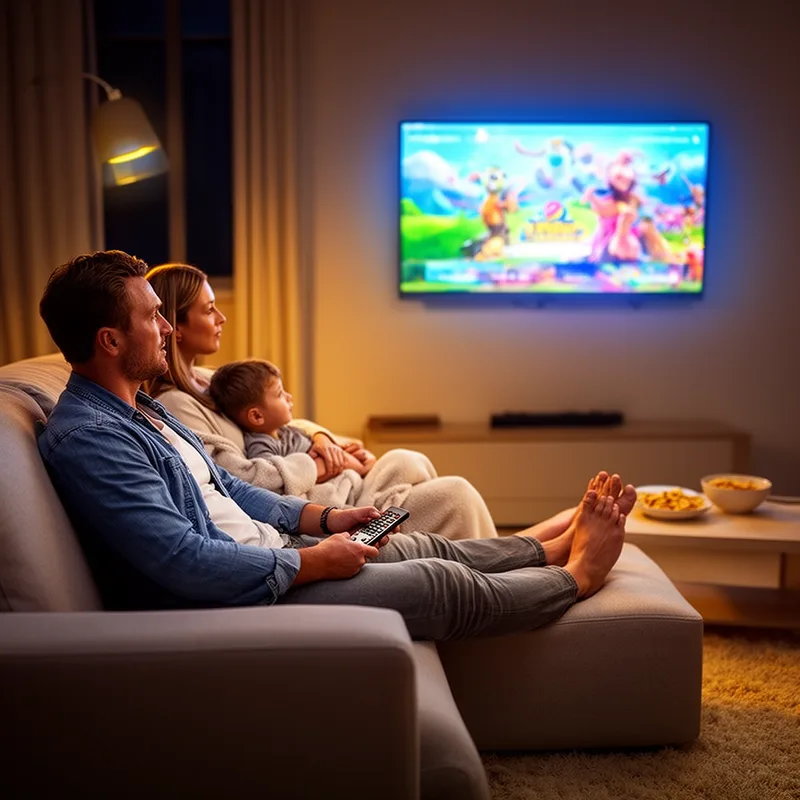
televiewing
- noun
- /ˈtɛlɪˌvjuːɪŋ/
 :
televisión
:
televisión
- Many parents worry about the amount of time their children spend on televiewing instead of reading books.
- children's televiewing
Examples
-
The Kaiser Family Foundation (1999; Foehr, Rideout, & Miller, 2001) found that nearly one-fifth (18%) of parents were unaware of the TV ratings, and only half of those parents who were aware of the ratings (40% of all parents) reported actually using the system to guide their children's televiewing.
Academic text (2007) -
It was also found that televiewing experience facilitated comprehension, although heavy consumption by children who do not possess the prerequisite visual literacy was ineffective.
Academic text (2003) -
As children age, parental monitoring and mediating of children's televiewing generally decline.
Academic text (2007) -
Sphere had come up with many technical innovations in the last few years; they were now making an automobile as good as the Volkswagen and had radio and televiewing equipment that required only three tubes.
Fiction book (1992) -
However, when they did intervene in their children's televiewing, they were most likely to utilize more restrictive forms of mediation.
Academic text (2007) -
Grandmothers reported being frequently bothered by their granddaughters' lack of manners, their televiewing habits, the way they treated their parents, their concepts about morality, their listening habits, the discipline they received from parents at home, the expectations parents were urging them to establish, and their choice of friends.
Academic text (1996) -
A series of 17 questions for each technology asked parents about the frequency (often, sometimes, rarely, never) with which they used certain interpersonal methods, in conjunction with TV ratings information, video game ratings information, V-chip technology, and Internet tracking and blocking software to control or guide their child's televiewing.
Academic text (2007) -
They were also more likely to apply restrictive methods of mediation, reinforcing the perception that undesirable behaviors resulting from televiewing can be reduced by restricting televiewing.
Academic text (2007) -
They were also more likely to apply restrictive methods of mediation, reinforcing the perception that undesirable behaviors resulting from televiewing can be reduced by restricting televiewing.
Academic text (2007) -
Desmond et al. (1990) found that parents who were primarily concerned with the behavioral effects of television (i.e., the medium influencing how children behave during and after viewing) were more likely to mediate their children's televiewing than other parents.
Academic text (2007)
Synonyms

 54
2.3
54
2.3

An event when people go to see something like a film or artwork

A long session of watching many TV episodes in one sitting

Spending a long time watching television and not doing much else
How Much

Surface Forms
Morphology
Etymology
Televiewing combines the prefix tele- meaning 'far' and view meaning 'to see', the same tele- you find in television and telephone. So televiewing means watching programs that are sent from far away, which is why it refers to watching television or broadcasts.