
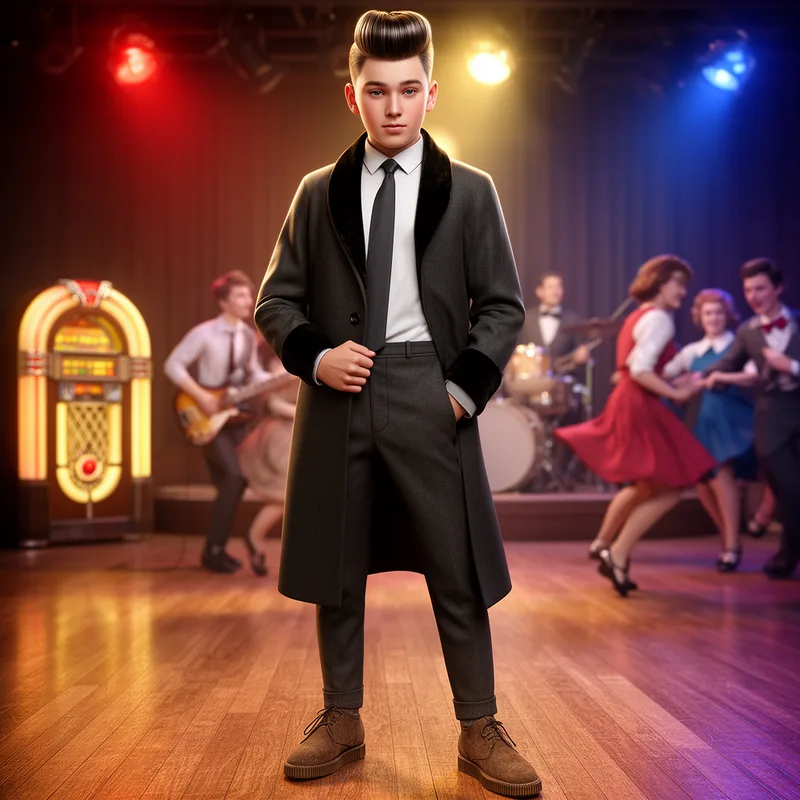
teddy boy
 1
9.9
1
9.9

- noun
- /ˈtɛdi bɔɪ/
- Archaic
Loading YouTube…
Watch on YouTubeI, I, I regret it, you know, we've gone through the era of teddy boys and street fights and God knows what else.
- I, I, I regret it, you know, we've gone through the era of teddy boys and street fights and God knows what else.
Examples
-
I, I, I regret it, you know, we've gone through the era of teddy boys and street fights and God knows what else.
-
The place was stuffed with gum-chewing teenagers, leather-clad teddy boys, and natty suit-and-tie lunch-crowd types.
Fiction book (1996) -
In the 1950s, he dressed like a teddy boy, complete with a quiff and sharp suit.
-
The film featured a group of rebellious teddy boys who loved rock and roll music.
-
At the youth club, many teddy boys gathered to show off their stylish Edwardian outfits.
Synonyms
 968
9.9
968
9.9
A young man in 1950s and 1960s Britain who wore smart old-fashioned clothes and liked to be rebellious
Surface Forms
Morphology
teddy + boy
The label 'teddy boy' denotes a specific 1950s youth subculture and this specialized, historical meaning cannot be predicted from the constituents. 'Boy' is transparent but 'teddy' is ambiguous (teddy bear, nickname for Edward, or a style label) and does not transparently signal Edwardian-style dress, so a B1 learner who only knows the parts would not reliably infer the MWE meaning.
Etymology
Teddy boy comes from 1950s Britain when young men copied old 'Edwardian' clothes; people called the style teddy (a short form of 'Edwardian') and added boy to mean a young man. That's why teddy boy refers to young men who wore Edwardian-style clothes and joined the 'rock and roll' youth scene.