
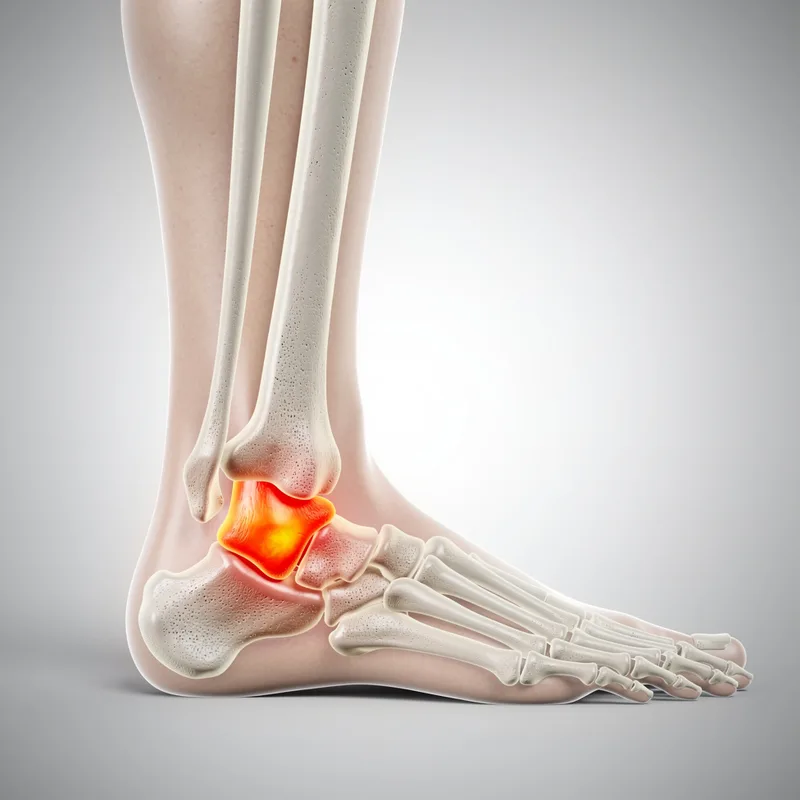
talus
 1
8.9
1
8.9

- noun
- /ˈtæləs/
- Specialized
- Injuries to the talus can lead to significant pain and difficulty in walking.
- congenital talus
- vertical talus
- talus and calcaneus
Examples
-
The ankle joint (2) is the joint between the talus and the tibia, and the subtalar joint (2,3) is between the talus and the calcaneus (Figure 1).
Academic text (1995) -
The talus connects the leg bones to form the ankle joint, providing essential movement and stability.
-
The wooden ankle block is shaped to fit directly over the talus.
Academic text (1990) -
The treatment of congenital vertical talus often involves surgical correction between the ages of 6 and 12 months.
Academic text (2005) -
Therefore, all patients with congenital vertical talus should have a careful evaluation for an underlying cause or associated disorder.
Academic text (2005) -
Both sexes are affected equally, and congenital vertical talus is bilateral in approximately 50% of cases.
Academic text (2005) -
The talus is shortened and deviated in a medial and plantar direction.
Academic text (2005) -
The most notable abnormalities include a hypoplasia of the tarsal bones, with reduced size and shortening of the talus.
Academic text (2005) -
Any deformity that is suspected to be a congenital vertical talus should always be referred to a pediatric orthopedic surgeon for evaluation and treatment.
Academic text (2005) -
During the examination, the doctor noted that the patient's talus was not properly aligned.
Synonyms

 1
4.0
1
4.0
A bone in the ankle that connects the leg to the foot
A small bone in the ankle that connects the leg to the foot

The bone in the ankle that connects the leg and foot
A bone in the ankle that connects the foot to the leg and helps the ankle move
Surface Forms
Etymology
Talus comes from the Latin word talus, which meant 'ankle', so the name stayed with the small bone that links the leg bones to the foot.