
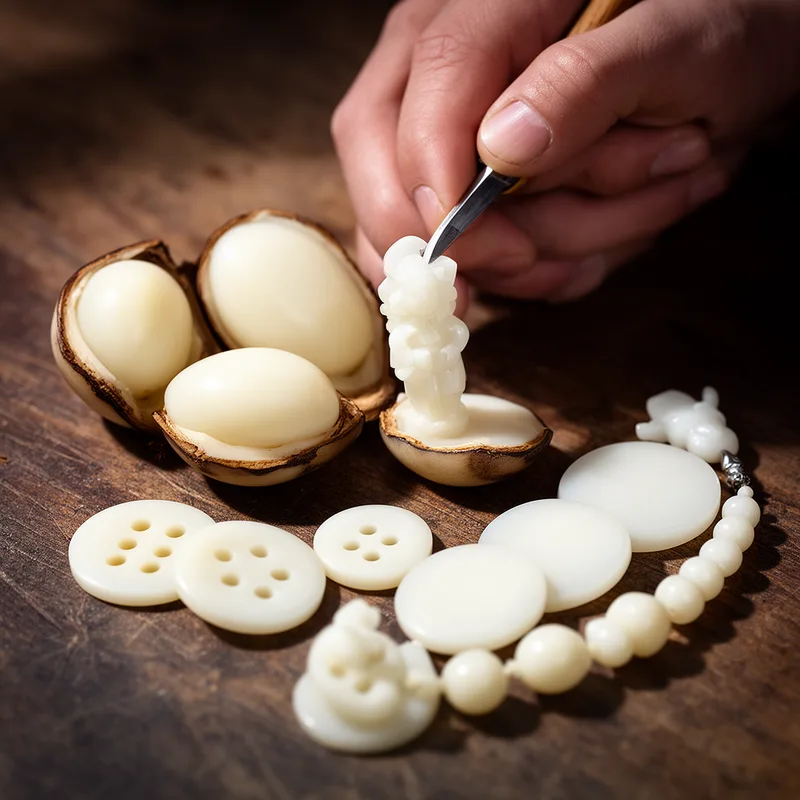
tagua
- noun
- /ˈtɑːɡwə/
- Since February 1990, 850 tons of tagua have been delivered directly to factories, and the program has generated approximately $2 million in button sales to manufacturers in North America, Europe, and Japan.
Examples
-
Conservation International links button manufacturers in the United States and other countries with rural tagua harvesters in the endangered rainforests of Esmeraldas in Ecuador.
Academic text (1993) -
Currently, the tagua production line has expanded to include eight manufacturers of jewelry, arts and crafts, and other items.
Academic text (1993) -
To increase the flow of income to the native economy, Conservation International encourages the development of new tagua products that can be manufactured locally.
Academic text (1993) -
Today, tagua buttons are being used by 24 clothing companies, including such major manufacturers as Smith & Hawken, Esprit, J. Crew, and L.L. Bean.
Academic text (1993) -
Moreover, the Tagua Initiative in Ecuador has become a role model for new projects in Colombia, Guatemala, Peru, the Philippines, and a number of other countries.
Academic text (1993) -
Recent figures indicate that the price paid to tagua collectors has risen 92 percent since the program began (a 32 percent real price increase after adjusting for the estimated inflation rate).
Academic text (1993) -
The nut of the tagua palm is often crafted into beautiful buttons that serve as a substitute for ivory.
-
Many artisans prefer using tagua for carvings due to its resemblance to ivory and sustainable sourcing.
-
Due to its unique properties, the tagua nut is an important resource for creating eco-friendly fashion accessories.
Synonyms

A hard white seed from some South American palms that people use to make buttons and small carved objects

A hard white seed from a South American palm used to make buttons and small objects
A hard white seed from a South American palm tree that people polish to make buttons
Surface Forms
Etymology
Tagua comes from a native South American word that entered Spanish to name a hard white 'nut' that looks like elephant 'ivory'. Because this nut can be carved like real ivory, people call it 'vegetable ivory' and use it for buttons and carvings.

