
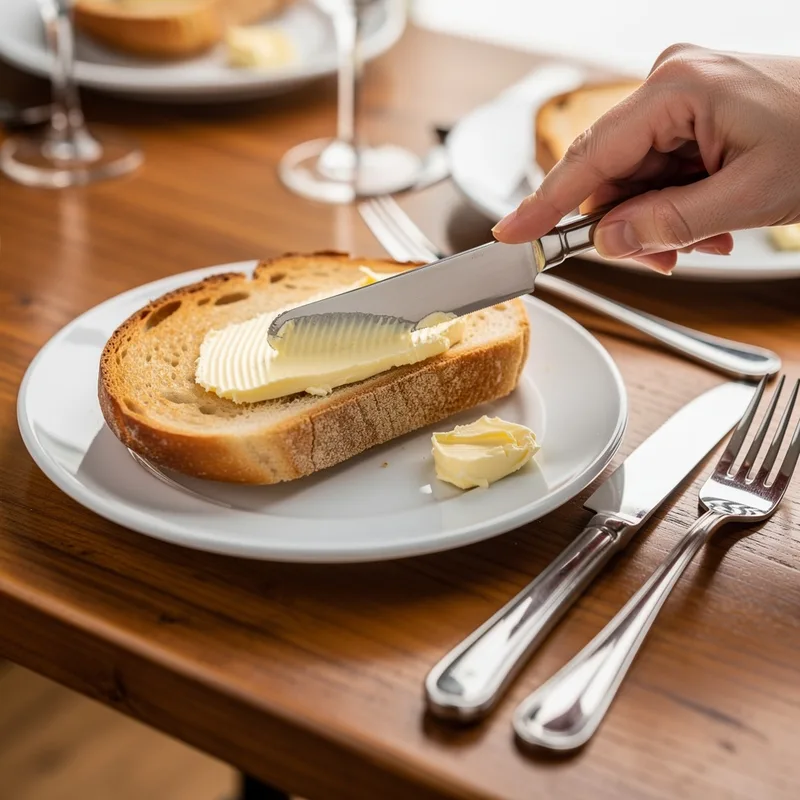
table knife
 1
1.0
1
1.0

- noun
- /ˈteɪbəl naɪf/
- He goes to the silverware drawer, takes out a table knife, heads back to the front room where he jams the blade into the crack under the doorway casing so that the knife makes the door unopenable.
Examples
-
Carefully loosen corners with a table knife.
Blog text (4) -
She smiled, shaking the table knife like a finger.
Fiction book (2002) -
That table knife, please put it back.
-
That's a sharp table knife you got.
-
I always do a lot of cooking while I'm there, and their knives are like trying to chop with a table knife.
Blog text (34) -
She lunged for a table knife and brought it up to stab herself in the chest.
Fiction book (2002) -
A table knife from an ancient pattern is there on the table, obviously used to pry open cans in the absence of a slotted screwdriver.
Fiction book (1992) -
I slashed it with a table knife, split it with my thumbs, and plunged my mouth into the bright yellow pulp of it.
Fiction book (1990) -
Jason rummaged in the silverware drawer, feeling and discarding the curved handles of forks and spoons until he found a table knife.
Fiction book (2002) -
She used a table knife to spread butter on her toast.
Synonyms
A knife with a rounded end used for spreading butter and eating soft foods
How Sharp

Surface Forms
Morphology
The meaning 'a knife used for eating at a dining table' is directly and compositionally derived from 'table' (dining/table) + 'knife' (cutting implement). This noun–noun compound is a common, cross-linguistic naming pattern (e.g., French 'couteau de table', Spanish 'cuchillo de mesa') and would be understandable to a B1 learner who knows both constituents.
Etymology
Table knife comes from the everyday knife kept at the dining table for eating and for spreading butter or soft food. Because these knives had a blunt edge and were safe to use beside your plate, the term came to mean 'a knife with a blunt edge used for eating'.