
synectics
- noun
- /sɪˈnɛtɪks/
- Specialized
- In synectics exercises, students "play" with metaphors until they relax and begin to enjoy using their imagination through metaphoric comparisons.
Examples
-
Tom Gordon (1971) also makes a case in his work on synectics that personal metaphors are a way to get students to think about the familiar and make it strange and different.
Academic text (2001) -
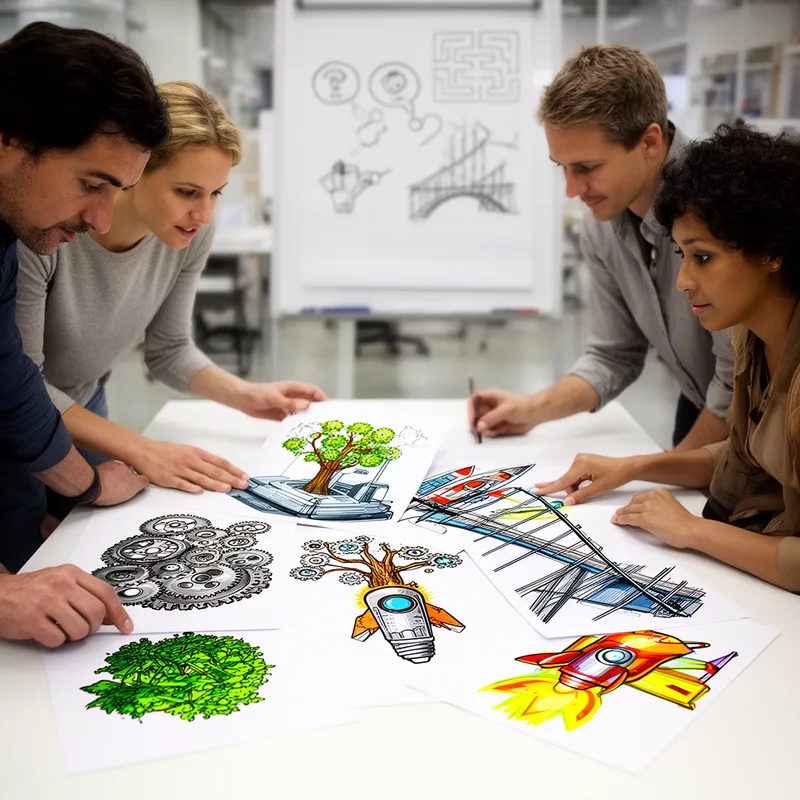
The synectics approach encourages creative problem-solving through the combination of unrelated thoughts.
-
Gordon (1971) says that when the logical doesn't work, synectics is designed to lead students into a slightly illogical work.
Academic text (2001) -
Some models that are considered include inquiry synectics, advance organizers, jurisprudence, principles of cooperative learning and problem solving, discrepant events, and so forth.
Academic text (1993) -
Myoelectrical activity of the external anal sphincter was recorded by one reference and two differential electrodes connected to a bioamplifier and the PC Polygraph HR (Synectics Medical).
Academic text (2000) -
Teachers often use synectics to help students generate innovative ideas by linking unusual concepts.
-
In workshops, participants engage in synectics to foster inventive solutions by merging different perspectives.
Synonyms

 14
3.0
14
3.0

A group meeting to think of many ideas quickly without judging them
 6
7.9
6
7.9
To think of new plans or solutions for a problem
 5
3.7
5
3.7
Thinking in new ways to make things or solve problems
 1
5.3
1
5.3
A way to solve problems by looking at them from new angles
 1
4.4
1
4.4
To solve problems using new creative ideas


 1
6.4
1
6.4
A way to find new ideas that ignores practical limits

A way of thinking that comes up with many different ideas to solve a problem

A way of teaching that uses new ideas and activities to help students learn
How Creative

Surface Forms
Etymology
The word synectics starts with syn- meaning 'together', as in synchronize, and it suggests 'bringing things together' like the common word connect. So, synectics is a creative method that helps you join different ideas to solve a problem.