
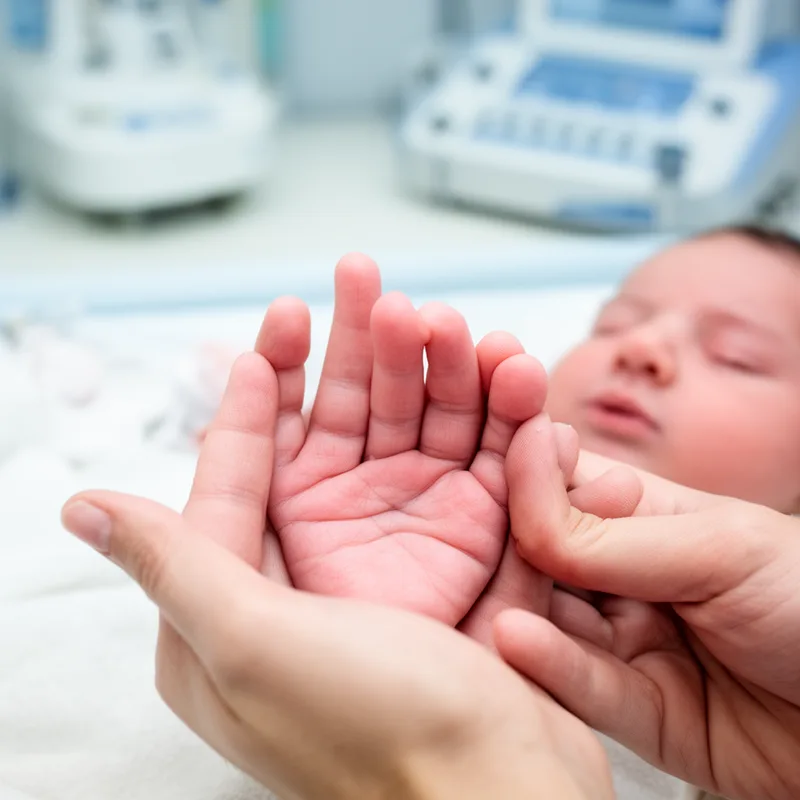
syndactyly


 1
9.9
- noun
- /ˌsɪnˈdæktəli/
- Specialized
- Parents should be counseled that surgical separation or release of the syndactyly will often require skin grafts and will replace the webbed toes with a scar.
Examples
-
The diagnosis of syndactyly was made after the doctor examined the newborn's hands.
-
His physical examination was otherwise unremarkable except for an incomplete syndactyly of the second and third toes.
Academic text (2015) -
Syndactyly was observed in five cases in the hands and two cases in the feet.
Academic text (2015) -
Syndactyly in the foot does not cause any functional problems, and treatment is therefore not usually recommended.
Academic text (2005) -
Syndactyly may also be present in combination with polydactyly.
Academic text (2005) -
Unlike syndactyly of the hand, which requires surgical separation, webbing of the toes will not cause any functional problems or limitations.
Academic text (2005) -
Congenital Toe Deformities: Syndactyly and Polydactyly.
Academic text (2005) -
Syndactyly can also be classified as simple or complex and varies in the degree of severity from incomplete webbing of the skin of two digits to complete union of digits and fusion of the bones and nails.
Academic text (2005) -
Syndactyly is a congenital condition where two or more fingers are joined together due to syndactyly.
-
Children born with syndactyly may require surgery to separate the fused fingers for better function.
Synonyms
 1
9.9
A condition in which fingers or toes are joined by skin from birth
A condition where skin joins two or more fingers from birth
Antonyms

How Joined
- Specialized
1
9.9
 1
5.5
Surface Forms
Morphology
Etymology
Syndactyly comes from Greek parts syn- meaning 'together' and dactyl meaning 'finger', a piece you also see in pterodactyl. So, syndactyly describes fingers or toes 'joined together'.