
synchronism
- noun
- /ˈsɪŋkrəˌnɪzəm/
- To ensure smooth performance, the audio and video must be in synchronism during the presentation.
Examples
-
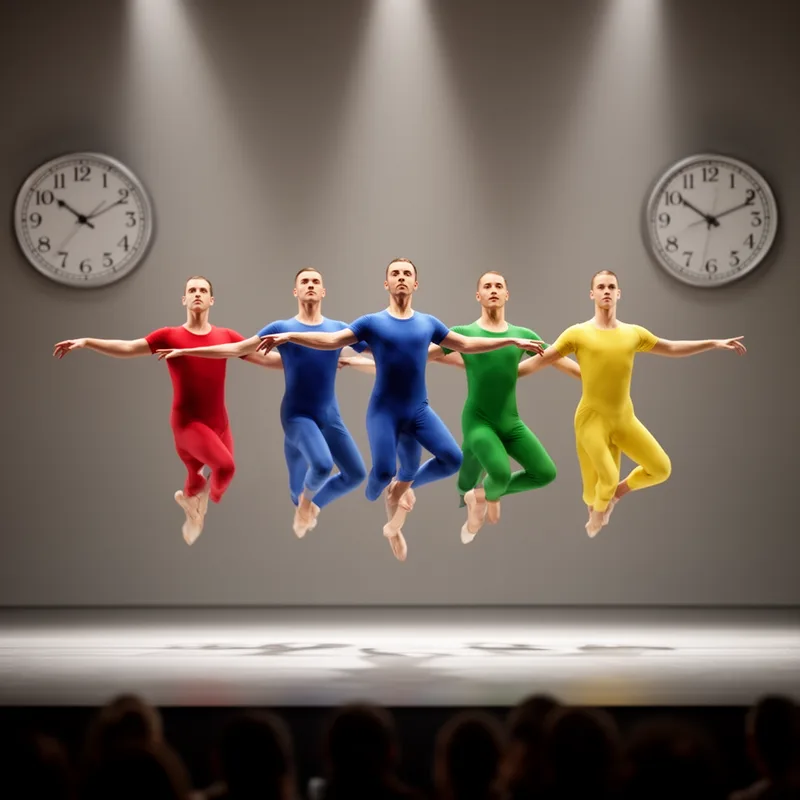
The two dancers moved in perfect synchronism during the performance.
-
The control parts of two L2 chips are identical and must always be in synchronism.
Academic text (1997) -
Not only were people in synchronism with the great cosmic cycle of rain and sun, but they were reenacting the deeds of the past....
Academic text (2003) -
Synchronism check
Academic text (1997) -
The editing here is a matter of simultaneity, of the synchronism of independent temporal sequences, projected outside of all collage.
Academic text (2004) -
Since the excitation of these correctors must be changed in synchronism with the deflection, these elements are therefore designated as dynamic correctors.
Academic text (2001) -
In Forsta varningen, Strindberg even alludes to this synchronism when, in the beginning, he has the Gentleman state that he is to leave in half an hour.
Academic text (1996) -
As depicted in a coordinate system rotating with the two primary bodies, Lagrange found five "equilibrium points" where a third body could theoretically rotate in synchronism with the first two.
Academic text (2005) -
In principle, separate deflection fields are needed to shift the beam in synchronism with the shifted axis so that it remains on the chosen curvilinear axis along the column and for every deflection position throughout the effective optical field.
Academic text (2001) -
The clocks in the library are adjusted to keep them in synchronism with the main clock tower.
Synonyms

 265
2.8
265
2.8

Two or more people act or speak at the same time
 12
4.7
12
4.7
The state of things happening at the same time
 2
6.7
2
6.7
A situation when events happen at the same time
 2
8.1
2
8.1
Two or more events happening at the same time
 2
9.3
2
9.3
Events happening at the same time in a matching way
 1
7.9
1
7.9
Two or more things happening at the same time


 1
7.2
1
7.2
Two or more things happening at the same time
 1
9.7
1
9.7
Happening at the same time as something else
 1
6.7
1
6.7
Perfect timing when people or machines move together

A state of things happening at the same time

Two or more things happening at the same time

More than one thing happening at the same time or in the same place

The fact of existing or happening at the same time as something else
Antonyms

How Synchronous
 1
7.9
1
7.9
Surface Forms
Morphology
synchronism = synchrony (transparent) = synchron + ism
The noun denotes the state of being simultaneous and is a regular -ism nominalization of the synchron- root; learners who know 'synchrony' or 'synchronize' can infer the meaning.
Etymology
Synchronism comes from the Greek parts syn- 'together' and chron- 'time', the same root you see in synchronize. So synchronism means things happening 'at the same time', like clocks or dancers moving together.