
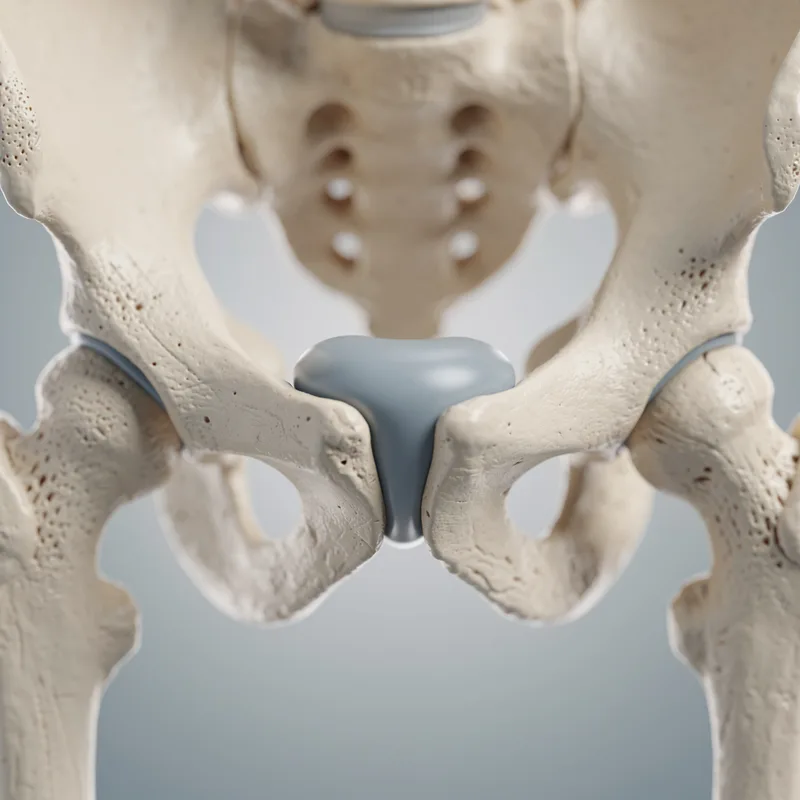
symphysis
 1
9.9

- noun
- /ˈsɪmfɪsɪs/
- Specialized
- The doctor explained that the symphysis serves as a cushion between bones, allowing for slight movement.
Examples
-
The symphysis acts more as a supporting strut because the SI joint is the stabilizing structure of the pelvic ring.
Academic text (2006) -
Tenderness can often be found over the PSIS, ASIS, and at the superior symphysis pubis.
Academic text (1997) -
The pelvic ring is formed by the connection of the sacrum to the innominate bones at the sacroiliac (SI) joints and the symphysis pubis.
Academic text (2006) -
The lower lip and external incisions were then repaired in a layered fashion with resuspension of the soft-tissue envelope to the mandibular symphysis (Figure 3).
Academic text (2010) -
Pathologic examination conducted during the first-stage operation revealed a positive margin at the mandibular symphysis, and a further 1.5 cm of the right parasymphyseal bone was resected during the free-flap reconstruction.
Academic text (1999) -
The urethra is pushed to one side (ideally having already placed a catheter before delivery of the head in anticipation), and then a scalpel is used to cut the 2-3 cm wide band of ligament holding the two halves of the symphysis together.
Blog text (3) -
After nasotracheal intubation, the mass was resected by dividing the mandible at the symphysis, freeing the tumor from the floor of the mouth, and dissecting to the area of the previously existing temporomandibular joint.
Academic text (1999) -
In the human body, the pubic symphysis is the joint where the two pubic bones meet.
-
An X-ray showed that the symphysis was intact, indicating no fracture in the pelvic region.
Surface Forms
Morphology
symphysis = sym + physis
Built from Greek combining forms ('sym-' + 'physis') that are not productive or familiar as standalone English words, so learners cannot reliably infer 'joining of bones' from the parts.
Etymology
Symphysis comes from two Greek parts: sym- meaning 'together' and -physis meaning 'to grow'. So a symphysis is like two bones 'growing together', which is why the word names a place where bones meet and fuse, often with cartilage between them.