
superior planet
- noun
- /suˈpɪrɪər ˈplænɪt/
- Specialized
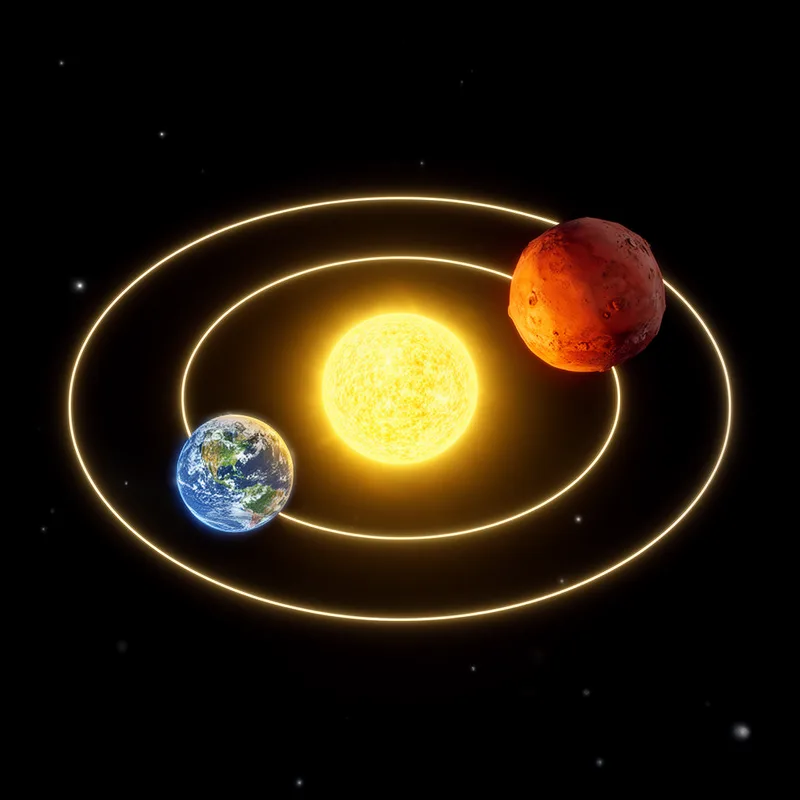
- Mars is classified as a superior planet because its orbit lies outside Earth’s.
Examples
-
Jupiter and Saturn are both superior planets.
-
The motion of a superior planet appears retrograde when Earth passes it in its orbit.
-
Astronomers once used the terms 'inferior planet' and superior planet to describe planetary positions in the Solar System.
-
Mars is a superior planet in our Solar System.
-
Mars is classified as a superior planet because its orbit lies outside Earth’s.
-
The motion of a superior planet appears retrograde when Earth passes it in its orbit.
-
Jupiter and Saturn are both superior planets that can be observed easily from Earth.
Antonyms

- Specialized
A planet that orbits closer to the Sun than Earth, like Mercury or Venus
Surface Forms
Morphology
The adjective 'superior' can mean 'higher' or 'situated above/farther' so there is a partial, compositional clue that a 'superior planet' is somehow 'outside' or 'above' Earth's position. However, the specific technical sense — a planet whose orbit lies outside Earth's — is domain-specific and can be confused with the common meaning 'better' without prior astronomical knowledge. Because the relation is partly derivable but requires subject-matter knowledge to be fully understood, it is best classified as semi-transparent.
Etymology
Superior planet comes from old astronomy where superior meant 'above' or 'outside' Earth's path. Astronomers used it for planets like Mars and Jupiter because their orbits are 'outside' Earth's, so today it means a planet whose orbit lies outside Earth's.

