
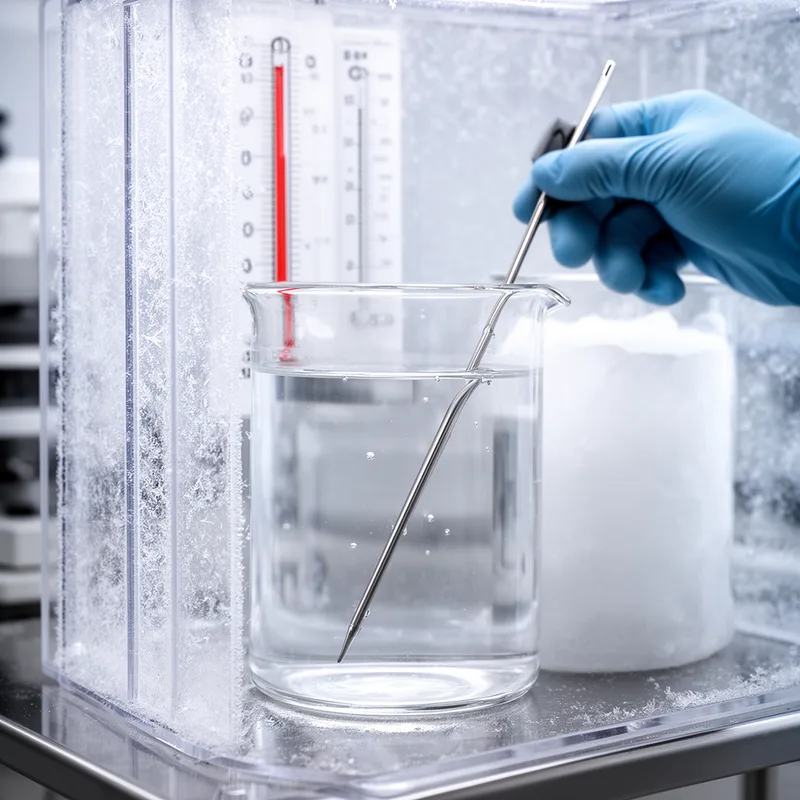
to supercool
- verb
- /ˈsuːpərˌkuːl/
- Specialized
- In the lab, scientists can supercool liquids to temperatures far below their freezing points without them solidifying.
Examples
-
They learned how to supercool the mixture effectively, allowing for a unique experiment in their chemistry class.
-
They supercool.
Academic text (2007) -
Supercooling the universe.
Academic text (2002) -
The challenge, then, is to supercool the liquid from TM to TG so fast that there's no chance for a crystalline phase to nucleate and grow.
Academic text (2012) -
The collective rearrangements needed to fulfill both requirements proceed slowly enough that even moderate cooling rates suffice to supercool a liquid to TG before it crystallizes.
Academic text (2012) -
In Alaska, yellowjacket queens of the species Vespula vulgaris survive the cold, hanging by their mandibles for nine months in a dry, snow-free cavity by allowing the fluids in their bodies to supercool.
Academic text (2007) -
To create ice crystals at the right size, you need to supercool the water just before it freezes.
How Cold
- Specialized

 770
1.0
770
1.0
 52
3.0
84
1.0
256
1.0
52
3.0
84
1.0
256
1.0
Surface Forms
Morphology
Etymology
Supercool comes from the start super- 'extra' and cool 'to make cold'. So to supercool a liquid is to make it colder than its usual freeze point without it turning into a solid.