

suborder Sauria
- noun
- /ˈsʌbˌɔrdər ˈsɔːriə/
- Specialized
- The suborder Sauria includes a wide variety of lizards, from geckos to iguanas.
Examples
-
Chameleons, well-known for their adaptive camouflage, are members of the suborder Sauria.
-
Many species in the suborder Sauria can regenerate their tails when threatened.
-
The suborder Sauria includes various species of lizards.
-
Did you know that suborder Sauria consists of chameleons and geckos?
-
Chameleons, well-known for their adaptive camouflage, are members of the suborder Sauria.
-
Many species in the suborder Sauria can regenerate their tails when threatened.
-
The suborder Sauria includes a wide variety of lizards, from geckos to iguanas.
Synonyms
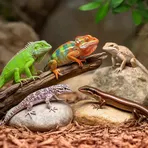
A group of reptiles that includes lizards like chameleons and geckos
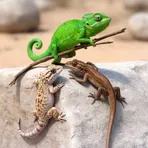
A group of reptiles that includes lizards such as chameleons and geckos
Surface Forms
Morphology
The phrase 'suborder Sauria' is compositionally transparent: 'suborder' denotes a taxonomic rank and 'Sauria' names the clade of true lizards, so a learner who knows both constituents can infer it refers to the taxonomic suborder containing those lizards. Although domain-specific, the noun + proper-name taxonomic pattern is regular and cross-linguistically common, making the meaning predictable for B1 learners familiar with the terms.
Etymology
Suborder Sauria comes from the old Greek word 'sauros' meaning 'lizard', and suborder means a smaller group inside a larger one. So suborder Sauria simply names a smaller group of true lizards, which is why it is used for animals like chameleons and geckos.

