
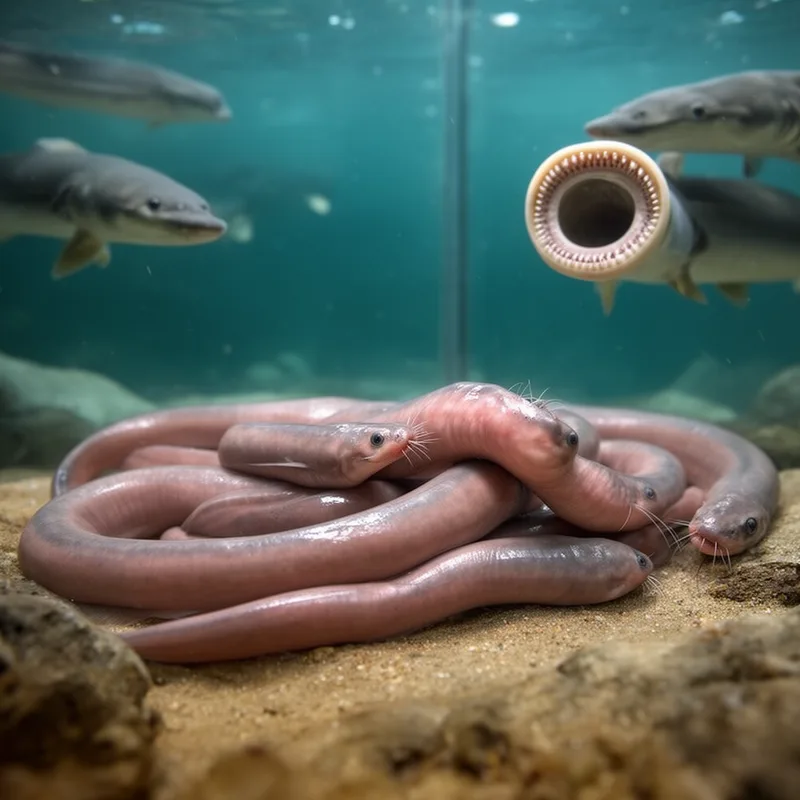
suborder Myxinoidei
- noun
- /ˈsʌbˌɔrdər mɪkˈsɪnɔɪdi/
- Specialized
- Unlike lampreys, species of the suborder Myxinoidei have elongated, eel-like bodies without vertebrae.
Examples
-
Scientists classify the hagfish within the suborder Myxinoidei due to their unique anatomical features.
-
The biology textbook contained a detailed section on the suborder Myxinoidei and its evolutionary history.
-
The suborder Myxinoidei includes unique jawless fish.
-
Have you studied the suborder Myxinoidei in biology class?
-
The biology textbook contained a detailed section on the suborder Myxinoidei and its evolutionary history.
-
Scientists classify the hagfish within the suborder Myxinoidei due to their unique anatomical features.
-
Unlike lampreys, species of the suborder Myxinoidei have elongated, eel-like bodies without vertebrae.
Synonyms

A group of deep sea jawless fish called hagfish that make lots of slime
A group of fish without jaws that includes hagfishes
A group of jawless sea animals called hagfishes with small feelers around their mouths that make slime

A type of fish without jaws, like a hagfish, that makes lots of slime
Surface Forms
Morphology
The phrase is fully compositional: 'suborder' denotes a taxonomic rank and 'Myxinoidei' names the particular group (hagfishes), so a learner who knows both constituents can infer it refers to that suborder of jawless fish. Taxonomic constructions like 'rank + name' are regular and cross-linguistically familiar, making the meaning predictable from the parts.
Etymology
Suborder Myxinoidei is the name scientists use for the group of eel-like hagfishes. The word Myxinoidei comes from a Greek word meaning 'slime', so imagine slimy, jawless fish, and that picture helps explain why this name refers to these hagfishes rather than to lampreys.

