
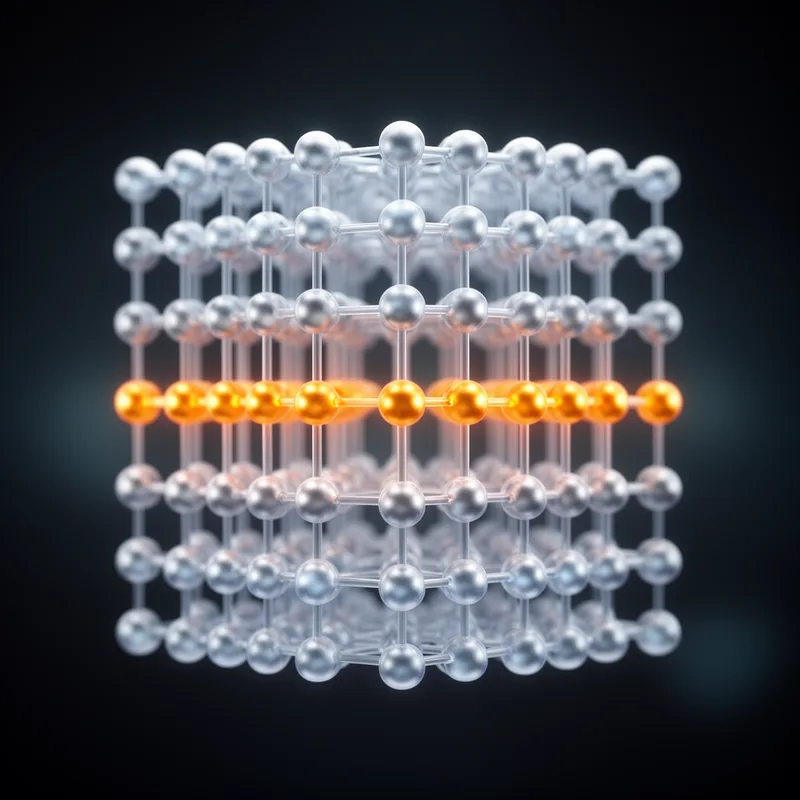
sublattice


 1
9.6
- noun
- /ˈsʌbˌlætɪs/
- Specialized
- Certain crystals consist of A and B atoms that, at low temperatures, are arranged in an orderly way, occupying two interlaced sublattices.
- invariant sublattice
- sublattice of index
Examples
-
In topology, a sublattice retains the properties of the original lattice while allowing for more complex structures to be analyzed.
-
The larger the sublattice magnetization, the larger the internal field on the conduction electrons, and the sooner superconductivity is killed.
Academic text (1998) -
In addition, there are a wide variety of temperature dependencies associated with the paramagnetic and ordered states of the rare earth sublattice.
Academic text (1998) -
We can now state the nonabelian version of the sublattice Weak Gravity Conjecture:
Academic text (2018) -
Lu is a magnetic zero in the Dy sublattice.
Academic text (1998) -
There is substantial evidence for the Sublattice Weak Gravity Conjecture in perturbative string theory, but at larger coupling the meaning of the conjecture is ambiguous.
Academic text (2018) -
This is consistent with the anisotropy of the Tm sublattice, which has a larger magnetization for Hc than for H when it is perpendicular to c.
Academic text (1998) -
In crystalline materials, the arrangement of atoms can form a sublattice that exhibits unique electrical properties.
-
The researchers discovered that the sublattice of the compound influenced its magnetic characteristics under varying temperatures.
Surface Forms
Morphology
Etymology
Sublattice comes from the prefix sub- meaning 'under' or 'below' and lattice, which means a 'grid' or 'structure'. So a sublattice is a smaller grid or structure that sits inside a larger lattice and still works like a lattice.