
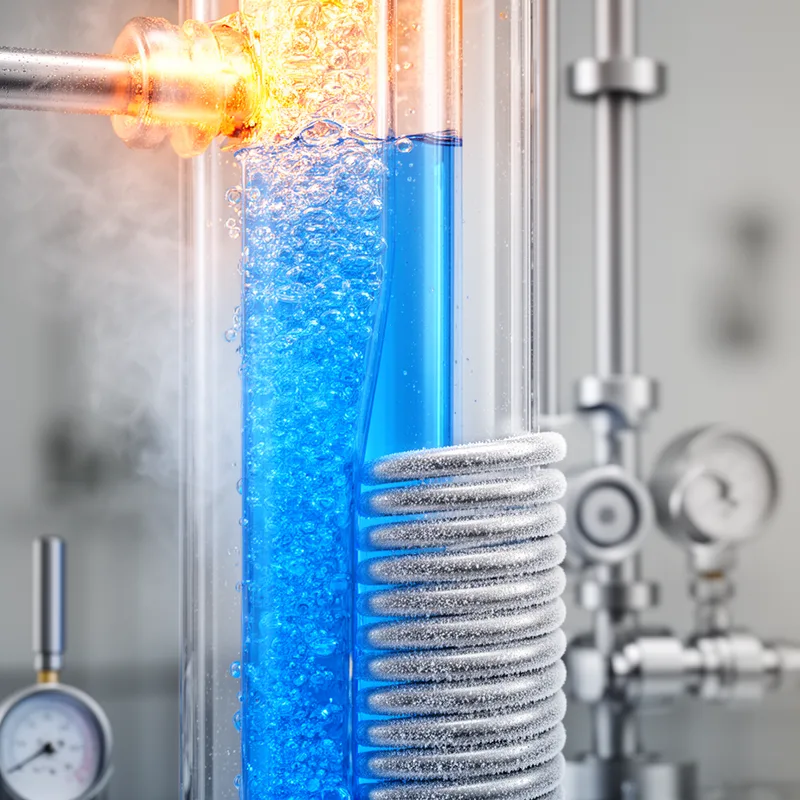
subcooling
- noun
- /ˈsʌbˌkuːlɪŋ/
- Specialized
- The process of subcooling the liquid in the refrigeration system helps improve its efficiency and energy usage.
Examples
-
The actual cycle is different from the ideal cycle because of the irreversibility of the actual process, which can be attributed to the following parameters: compressor efficiency, approach temperature in heat exchangers, pressure drop in heat exchangers, and degree of subcooling and superheating.
Academic text (1998) -
The approach temperature and degree of subcooling in the condensing process have the second and third largest impacts on the COP drop of N-22.
Academic text (1998) -
It should also have isentropic compression, no subcooling (for R-22), and no suction superheating.
Academic text (1998) -
He has clearly described the mechanism of bubble nucleation and growth, effects of liquid subcooling, and fundamental characteristics of flow boiling heat transfer in binary systems and on micro-finned surfaces.
Academic text (1998) -
The engineer explained that subcooling is essential for maximizing the performance of heat exchangers.
-
By adjusting the subcooling level, we can optimize the cooling process of the liquid in the system.
Surface Forms
Morphology
subcooling = subcool (transparent) = sub + cool + ing
The noun is formed by adding the productive noun-forming '-ing' to the verb 'subcool', which is directly analyzable as sub- (below) + cool.
Etymology
Subcooling starts with sub- meaning 'under' and the word cool meaning 'to make cold', like in submarine which is 'under the sea'. So subcooling means making a liquid colder than its normal boiling point so it stays liquid and works better in cooling systems.

