
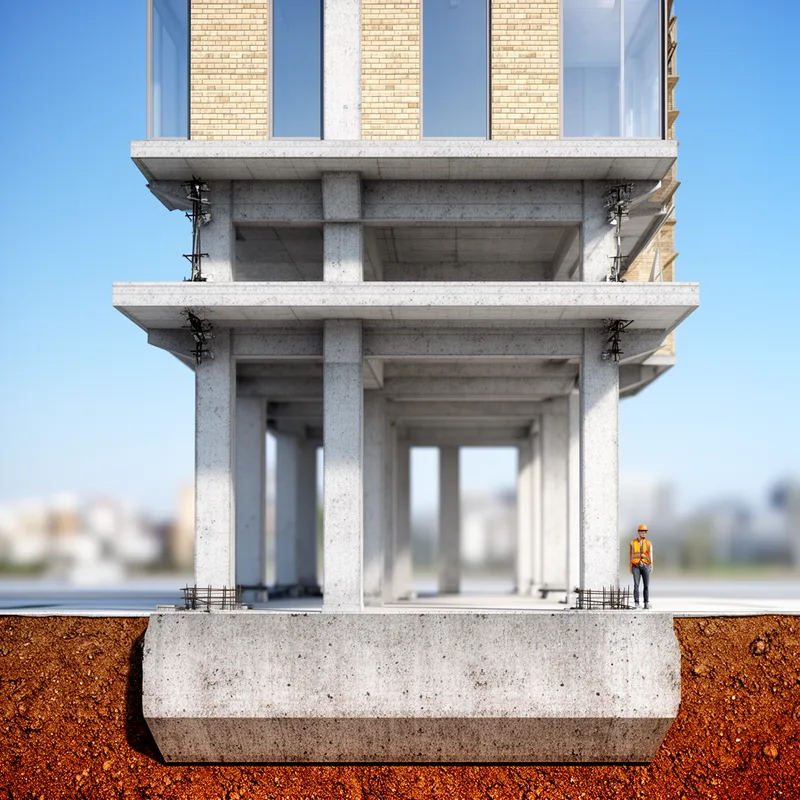
structural concrete
- noun
- Specialized
- The massive walls surrounding the vault are made of steel-reinforced structural concrete.
Examples
-
His research interests include the behavior and design of structural concrete with an emphasis on seismic evaluation, design, and retrofitting of bridges.
Academic text (2016) -
"For contributions advancing the use of fiber-reinforced concrete in structural concrete, mentoring students, and service on ACI technical committees."
Academic text (2016) -
The foundation of the building was constructed with high-strength structural concrete to support the entire structure.
-
Engineers use structural concrete for creating stability in large bridges and skyscrapers.
-
The architect specified structural concrete for the load-bearing walls to ensure the durability of the design.
How Strong
- Specialized
 5
3.7
5
3.7


- Specialized
2
2.8
- UK
Surface Forms
Morphology
The meaning ('concrete designed to bear structural loads') is directly and predictably derived from combining 'structural' (relating to load-bearing parts) with 'concrete' (a building material); the adjective simply specifies the function/type of the concrete. This compositional pattern is common in English and cross-linguistically, so a B1 learner who knows both constituents would readily infer the MWE's meaning.
Etymology
Structural concrete is concrete that is made to be part of a building's main support. The words structural and concrete create the image of solid concrete as the building's bones, 'to carry weight' and 'support' floors and walls, so it means concrete used to hold up a structure.