
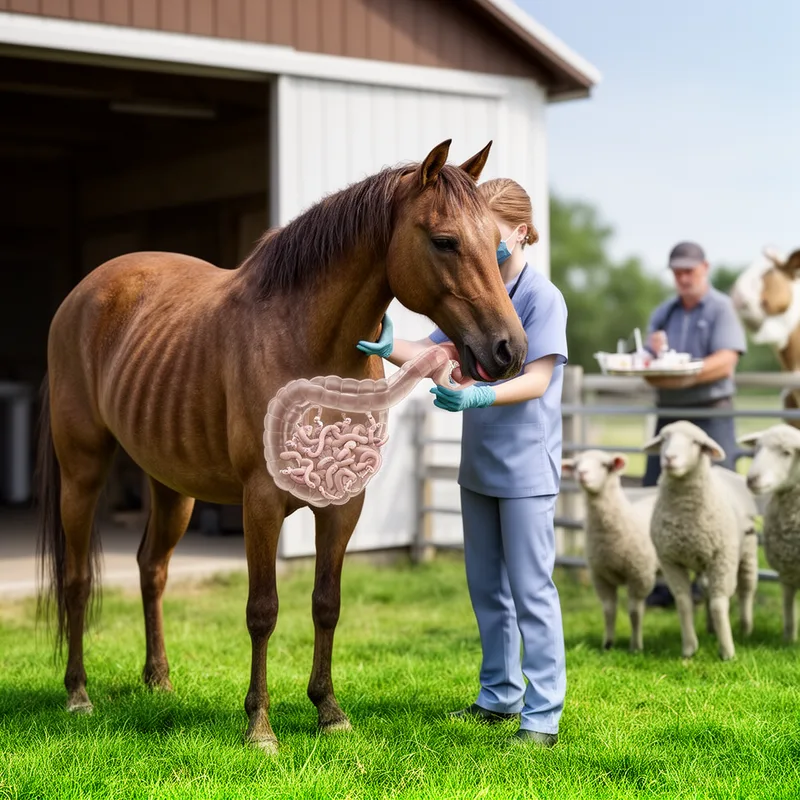
strongylosis
- noun
- /ˌstrɒŋɡɪˈloʊsɪs/
- Specialized
- After the examination, the veterinarian confirmed that the horse suffered from strongylosis.
Examples
-
The prevalence of strongylosis is not affected by age or sex (Saeed et al., 2010).
Academic text (2015) -
Climatic influences cannot effectively clean pastures from one grazing season to the next (Martin et al., 2007). The use of herbal compounds as anthelmintics against strongylosis is yet to be explored.
Academic text (2015) -
In broad terms, it is therefore necessary to avoid treatments of strongylosis during the winter months in cold temperate climates
Academic text (2015) -
A method for detecting mucosal larval stages would be valuable in the diagnosis of larval strongylosis.
Academic text (2015) -
In this report, the scientific knowledge about development, pathogenesis, clinical findings, diagnosis, epidemiology, treatment, and control of strongylosis in equines has been reviewed for a period of the last nine decades.
Academic text (2015) -
We review strongylosis, covering all aspects as it is one of the most important internal parasitic diseases of equines caused by nematodes of the Strongylidae family, affecting more than 80% of equids in the world.
Academic text (2015) -
Keywords: strongylosis; equines; S. vulgaris; arteritis; faecal floatation; migrating larvae.
Academic text (2015) -
If left untreated, strongylosis can cause severe health problems in horses and livestock.
-
To prevent strongylosis, farmers must regularly deworm their animals.
Antonyms

 ∞
1.0

The condition of a person's body and mind, especially being free from illness or injury
How Severe

Surface Forms
Morphology
Etymology
The word strongylosis comes from an old Greek root strongyl- meaning 'round' and the ending -osis meaning 'disease'. So strongylosis names the illness animals get from round worms called strongyles, which explains its modern meaning.