
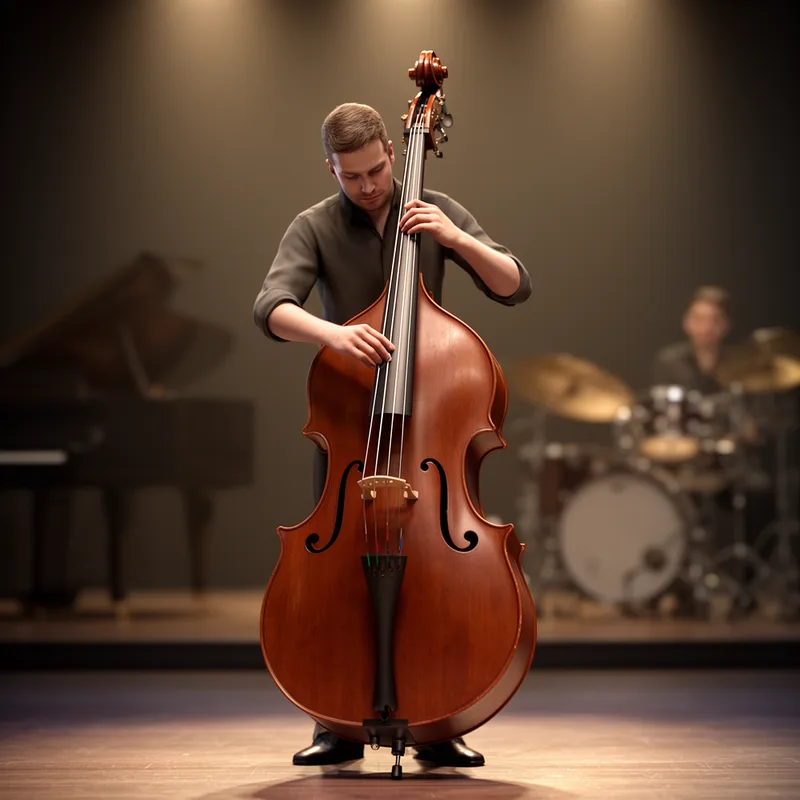
string bass
 1
3.7
1
3.7

- noun
- /strɪŋ beɪs/
- US
- Some alternative ensembles may greatly benefit from, or even require, that some members, such as string bass, guitar, or drum set players, acquire training in other ensembles.
Examples
-
Young Jimmy Blanton revolutionized the use of the string bass as a solo instrument in jazz.
Academic text (1999) -
Before becoming committed to his research, Gordon played string bass with the Gene Krupa Band.
Academic text (1999) -
The next four bars were the string bass and drums.
Academic text (2013) -
There are some exceptions, as traditional ensembles will provide training on some instruments, such as string bass and percussion, but most alternative ensembles will require separate instruction.
Academic text (2009) -
Even in the 1980s, fewer than 15 percent of the orchestra members who played percussion instruments, the string bass, or the "heavier brasses" (any but the French horn) were women.
Academic text (1993) -
The group in its earliest form consisted of Slye, Nolan, and Spencer on vocals, with Nolan playing string bass and Slye on rhythm guitar.
Blog text (6) -
Furthermore, while originally a violin method, the Suzuki publications presently include cello, piano, viola, and flute, with oboe, harp, and string bass publications in preparation.
Academic text (1996) -
The orchestra featured a rich harmony brought to life by the deep tones of the string bass.
-
During the performance, the string bass provided the foundational rhythm that anchored the entire band.
-
In jazz music, the string bass often takes on a prominent role, adding depth and warmth to the sound.
Synonyms
 115
4.1
115
4.1
An instrument with a low sound that plays the lowest part in a band
 1
3.6
1
3.6
A large string instrument with four strings that makes very low sounds when played with a bow or plucked


 1
4.7
1
4.7
A very large violin that makes very low sounds
The largest instrument in the violin family with very low notes used in orchestras

A very large string instrument like a big violin that makes low sounds
How Low-Pitched

Surface Forms
Morphology
The meaning is directly compositional: 'string' (the bowed/string family) + 'bass' (the lowest-pitched instrument) yields the lowest-pitched member of the string family (double bass). This straightforward noun–noun naming pattern is common across languages and follows normal English compounding, so a B1 learner who knows both words can infer the MWE's meaning.
Etymology
String bass comes from the words string (because it is played with strings) and bass (because it makes very 'low' notes). That's why the name means the largest, lowest instrument used in orchestras and jazz bands.