
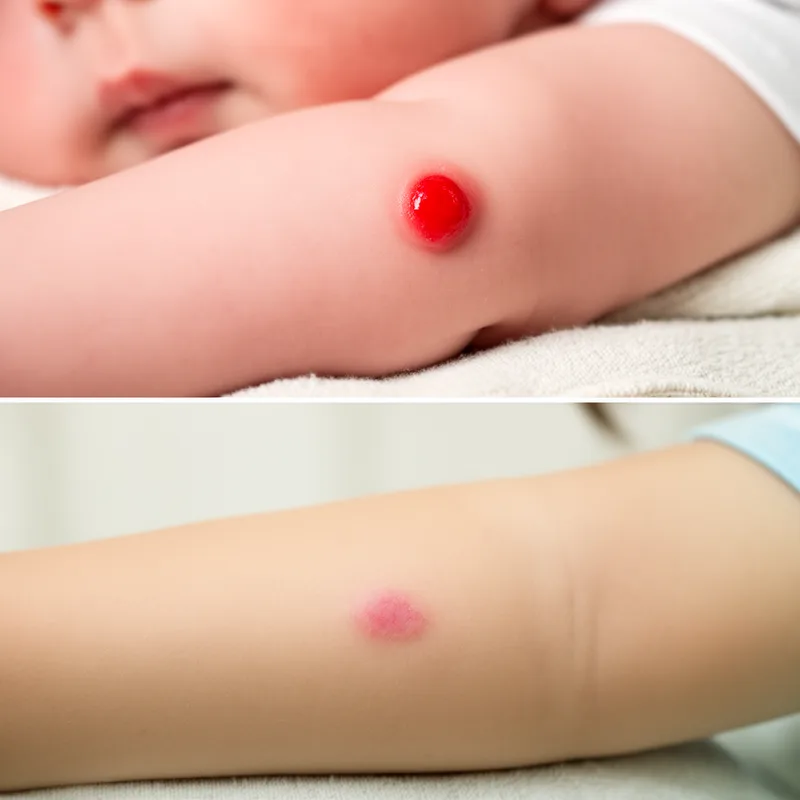
strawberry hemangioma
- noun
- /ˈstrɔˌbɛri hɪˈmænʤiˌoʊmə/
- Specialized
- Parents were relieved to learn that a strawberry hemangioma is generally harmless and tends to shrink as the child grows.
Examples
-
The pediatrician explained that the red mark on her arm was a strawberry hemangioma and would likely fade over time.
-
Many strawberry hemangiomas do not require treatment unless they interfere with vision or breathing.
-
The baby has a strawberry hemangioma on her forehead.
-
Many children with a strawberry hemangioma grow out of it.
-
The pediatrician explained that her daughter's strawberry hemangioma would likely fade as she grows older.
-
Parents often feel relieved when they discover that a strawberry hemangioma is usually harmless.
-
Many children with a strawberry hemangioma experience spontaneous regression over time.
Synonyms
 16
8.1
16
8.1

A soft raised red mark on a baby's skin that often fades over time
 1
9.9
1
9.9
A soft lump of blood vessels in the skin that looks like a red birthmark

A soft red raised birthmark on a baby's skin that looks like a strawberry

A soft red birthmark made by extra blood vessels just under the skin
Surface Forms
Morphology
The phrase is directly compositional: 'strawberry' describes the appearance (bright red, raised, fruit-like) and 'hemangioma' names a vascular birthmark/tumor, so the combined meaning — a hemangioma that looks like a strawberry — is predictable from the parts. This follows standard English noun–noun modification and similar descriptive compounds exist cross-linguistically, so a learner who knows both constituents would readily infer the MWE's meaning.
Etymology
The noun strawberry hemangioma is named for how the bright red, raised spot looks like a small strawberry, and hemangioma means a group of small blood vessels. So, the name points to a red 'birthmark' that usually 'gets smaller' as the child grows.