

to stop the bleeding
 50
5.1
50
5.1

- idiom
- Informal
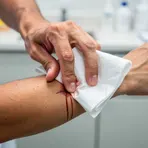
- The paramedic worked quickly to stop the bleeding from the injured man's arm.
Loading YouTube…
Watch on YouTubeThis stuff cauterizes the wound and it can help stop the bleed.
- This stuff cauterizes the wound and it can help stop the bleed.
- Well, a tourniquet stops the bleeding, perhaps at the cost of a limb.
- So if I teach one girl stop the bleeding, it saves a life.
- So you get an instant response of some the blood going there to stop the bleeding.
- And then also the guy says to me, he's like, sometimes nipple stimulation can help stop the bleeding.
Examples
-
We've just got to stop the bleeding and you'll be fine.
-
The hotel was hemorrhaging millions of dollars, and we sought to stop the bleeding immediately.
Blog text (28) -
It's the only way to stop the bleeding.
-
I just have to stop the bleeding.
-
I must stop the bleeding.
-
Otherwise, first aid should be provided to stop the bleeding.
Academic text (2012) -
We've got to stop the bleeding.
-
I held a napkin over my eye to stop the bleeding.
Fiction book (2000) -
For example, if someone is bleeding profusely, doctors will always try to stop the bleeding.
Blog text (19) -
We'll stop the bleeding.
Synonyms
 5
7.5
5
7.5
To stop the flow of blood from a wound
How Recovered
748
2.5
 157
3.2
157
3.2
- Informal
50
5.1
42
3.4
Surface Forms
Morphology
The meaning is directly compositional: 'stop' (to cease) + 'bleeding' (loss of blood) yields 'halt the loss of blood', which a B1 learner who knows the words can infer. The extended metaphorical use (e.g., stop financial losses) remains similarly interpretable as 'stop the loss', a transparent figurative extension that is cross-linguistically common.
Etymology
Stop the bleeding comes from a simple first-aid image: someone presses a wound to stop the bleeding so blood no longer flows. That's why we now say it to mean 'stop further loss' or 'prevent more damage' in money, work, or other problems.