
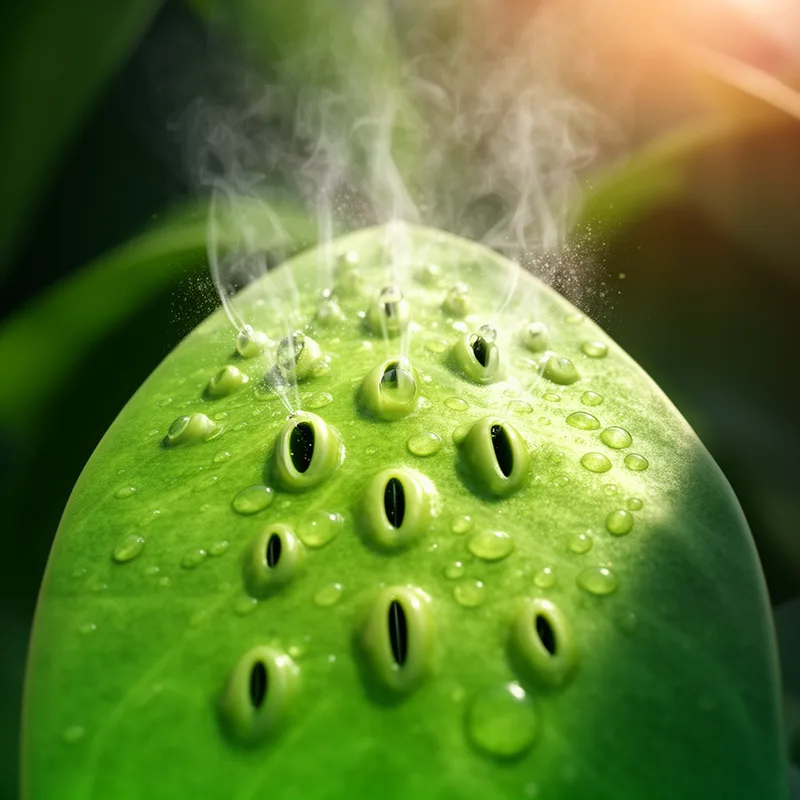
stomatal


 1
8.2
- adjective
- /stəˈmætəl/
- Specialized
- The stomatal openings on leaves allow plants to absorb carbon dioxide from the air for photosynthesis.
- stomatal conductance
- stomatal distribution
Examples
-
Although one might assume that a green stem should lose relatively little water because it is essentially leafless, some desert plant stems actually have moderate transpiration rates, with stomatal conductance similar to that of leaves on the same plant (Comstock and Ehleringer 1988).
Academic text (1998) -
In particular, transpiration is coupled with photosynthesis and plant primary production through stomatal regulation, which modulates water vapor and carbon dioxide (CO2) exchanges with the atmosphere.
Academic text (2010) -
Thus, both stomatal distribution and mesophyll cell area contribute to the higher rates of photosynthesis in sun leaves.
Academic text (1997) -
An alternate method based on stomatal density on leaves clearly shows historical fluctuations in CO2, not perfectly flat.
Blog text (9) -
Stomatal guard cells (with chloroplasts) will receive less intense light on a curved surface.
Academic text (1997) -
Stomatal patterns are mainly a design to maximize rates of CO2 uptake, not to prevent water loss.
Academic text (1998) -
Ozone comes into contact with plants through "stomatal conductance," or the uptake of ozone through small pores on a leaf or stem (stomates).
Academic text (2003) -
Evaluation of the relationship among leaf thickness, stomatal distribution, and whole-leaf photosynthesis could provide ecophysiological evidence for the importance of the overlap of light and carbon dioxide gradients inside the leaf.
Academic text (1997) -
There is also evidence that stomatal opening and closing in hypostomatous shade leaves occur in response to the much greater amount of sunlight that is incident on the upper leaf surface (over 20-fold greater) and propagates to the lower epidermis, where the stomata are present (Smith 1981).
Academic text (1997) -
The cause of the decline in evapotranspiration is not known but probably reflects decreases in transpirational water loss by vegetation that result from changes in vegetation composition, structure, or productivity, or from possible reductions in stomatal conductance owing to increasing atmospheric carbon dioxide concentrations.
Academic text (2012)
Synonyms
Small openings on a leaf or stem that let air and water vapor pass
Antonyms
Surface Forms
Morphology
Etymology
Stomatal comes from the Greek root stoma, which means 'mouth' or 'opening', so you can think of a plant's stomata as tiny mouths on its leaves. That's why stomatal describes things relating to those small openings that let air and water move in and out.