

stoa
- noun
- /ˈstoʊə/
- Specialized
- The columnar hall of the facade resembles a Greek stoa, and it has been suggested that Schinkel's proposed mural cycle was inspired by the Stoa Poikile in Athens.
- Stoa of Attalos
- Painted Stoa
Loading YouTube…
Watch on YouTubeHe starts teaching at the Stoa Poikile, the painted porch in Athens.
- He starts teaching at the Stoa Poikile, the painted porch in Athens.
Examples
-
Behind the Stoa of Attalos, the main public building of the ancient Athenian market, a fourth-century
Academic text (2010) -
The Greek stoa was placed in a frontal Roman composition by elevating it on a podium with a central staircase, and Schinkel's efforts to maintain a parallel relationship between the museum and the palace opposite suggest the importance of the symmetrical frontal axis.
Academic text (1990) -
And so the Stoa is a a painted porch or a a big covered colonnade.
-
He starts teaching at the Stoa Poikile, the painted porch in Athens.
-
In ancient Athens, people would gather for discussions under the shaded area of the stoa in the Agora.
-
The stoa of Attalos was an important gathering place for citizens to exchange ideas and goods.
-
Visitors to the ancient city often admired the intricate columns of the stoa while learning about its historical significance.
Synonyms

 8
7.9
8
7.9

A covered entrance to a building with columns like a porch
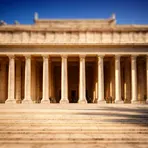
A covered walkway supported by columns at the front of Roman or Greek buildings
How Grand
- Specialized
4
7.9

- Specialized
- Specialized
74
4.2
4
3.7
Surface Forms
Etymology
Stoa comes from an old Greek word for a 'covered porch' or walkway with columns where people met and walked in the market. That's why a stoa is a covered public walkway in ancient Greece.