
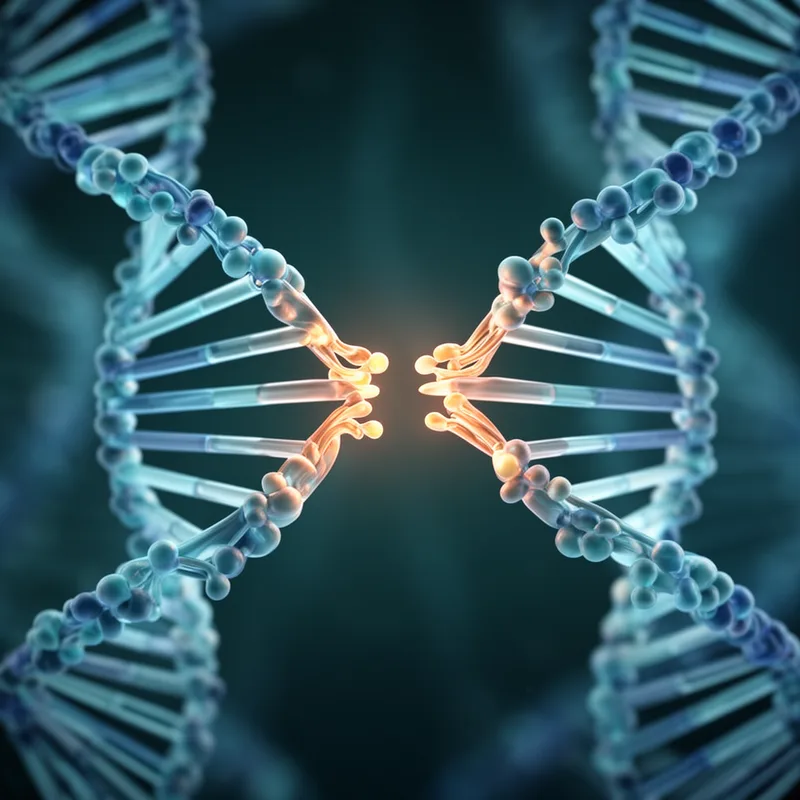
sticky end
- noun
- /ˈstɪki ɛnd/
- Specialized
- And in order to get sticky ends to ligate, those sticky single stranded bits have to base pair with one another.
Loading YouTube…
Watch on YouTubeIf you cleave a circle, now you have a linear piece of DNA, OK, But it has sticky ends, right?
- If you cleave a circle, now you have a linear piece of DNA, OK, But it has sticky ends, right?
- And in order to get sticky ends to ligate, those sticky single stranded bits have to base pair with one another.
Examples
-
When scientists prepare DNA for cloning, they often create sticky ends to facilitate the bonding of complementary sequences.
-
In genetic engineering, the creation of sticky ends is crucial for the successful assembly of DNA fragments.
-
If you cleave a circle, now you have a linear piece of DNA, OK, But it has sticky ends, right?
-
And so when it cuts, it leaves sticky ends or unbased paired single stranded regions on each end of the part it's cut, right.
-
The sticky ends of the DNA strands allow for the easy formation of bonds during the ligation process.
Surface Forms
Morphology
The literal senses of 'sticky' (adhering) and 'end' (final point) do not compose to mean an unpleasant or disastrous outcome, so a B1 learner knowing both words would not reliably infer the idiomatic sense. Although 'sticky' can sometimes mean 'troublesome' (e.g. 'in a sticky situation'), the specific phrase 'sticky end' is a conventional idiom with a historical/figurative meaning (often violent or calamitous) that is not predictable from its parts.
Etymology
Sticky end in biology names a DNA end where one strand sticks out a little like a short, sticky tail; that exposed piece can fit a matching piece, so it helps DNA fragments 'join' together.

