
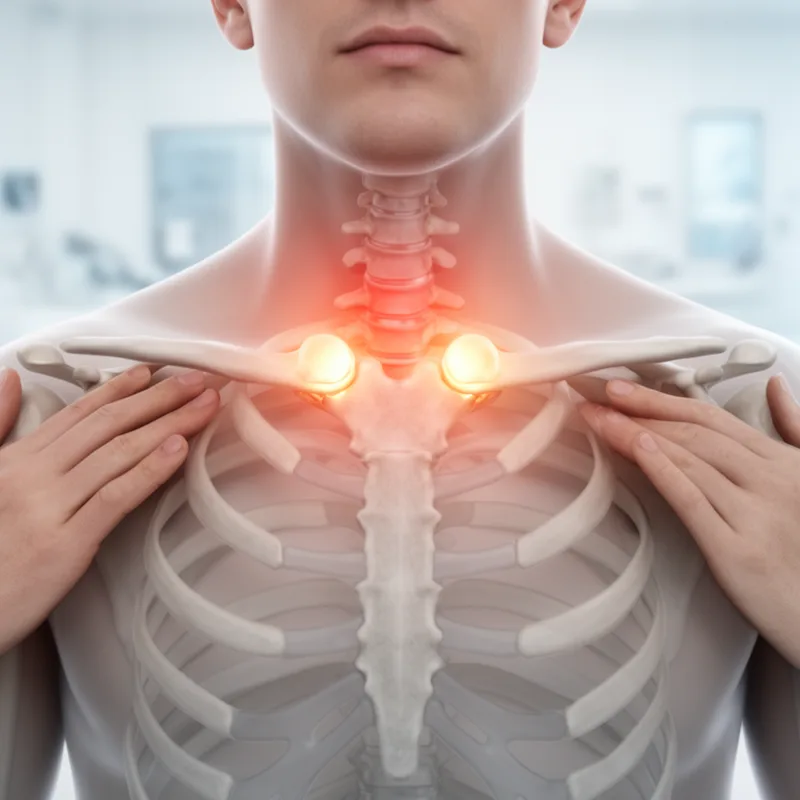
sternoclavicular


 1
9.3
- adjective
- /ˌstɜrnəʊkləˈvɪkjʊlər/
- Specialized
- There are 4 joints that make up the shoulder complex: the glenohumeral (GH) joint, acromioclavicular joint, sternoclavicular joint, and the functional scapulothoracic articulation.
- sternoclavicular joint
- sternoclavicular dislocation
Examples
-
He suffered a left sternoclavicular joint dislocation for which a Kirschner wire (K wire) fixation was done at his local hospital.
Academic text (2007) -
The doctor explained that a sternoclavicular dislocation can cause significant pain in the chest area.
-
Treatment of sternoclavicular dislocations is usually done by closed reduction.
Academic text (2007) -
We report here a case of migration of two Kirschner wires used for fixation of the sternoclavicular joint.
Academic text (2007) -
Traumatic dislocation of the sternoclavicular joint usually results from indirect force on the anterior shoulder with the arm abducted.
Academic text (2007) -
Both passive and active range of motion are evaluated, and a detailed examination of the shoulder girdle includes inspection and palpation of the acromioclavicular and sternoclavicular joints.
Academic text (2003) -
The mass invaded the 1st and 2nd ribs, 2 medial of clavicle, lateral part of manubrium sterni, and sternoclavicular joint, and the destruction was significant in these structures.
Academic text (2007) -
Physical therapy often focuses on strengthening the muscles around the sternoclavicular joint after an injury.
-
Injuries to the sternoclavicular joint may limit the range of motion in the shoulder.
Surface Forms
Morphology
Etymology
Sternoclavicular joins two bone names: sternum 'breastbone' and clavicle 'collarbone', with the ending -ar meaning 'relating to'. So, sternoclavicular refers to the area or joint where the breastbone and collarbone meet.