
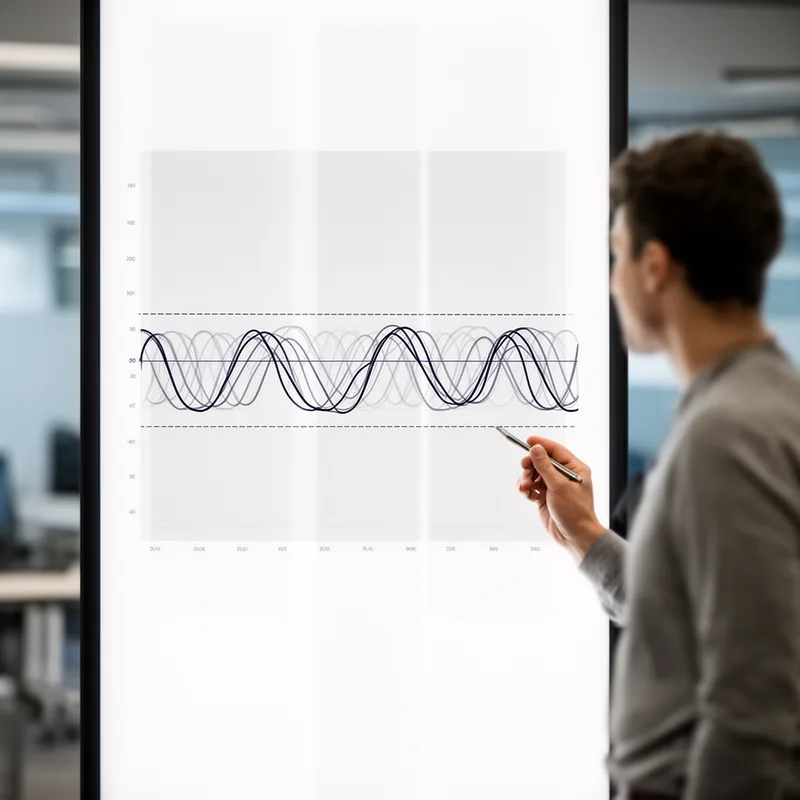
stationarity


 1
8.9
1
8.9
- noun
- /ˌsteɪʃəˈnɛrɪti/
- Specialized
- The stationarity of the temperature data allows us to predict future trends reliably.
- testing for stationarity
Examples
-
To investigate the stationarity properties of our data, we performed the augmented Dickey-Fuller (1979) and Phillips-Perron (1988) tests for a unit root in the price spread.
Academic text (2001) -
Before identifying the time series model generating the data, we investigated the data's stationarity properties.
Academic text (2001) -
OK, so it's a nice example of where you have wide sense stationarity, but you don't have stationarity.
-
This is exactly what statisticians do when testing for autocorrelation and stationarity.
Blog text (9) -
After testing for stationarity, contemporaneous and inter-temporal relationships, we estimate a VAR system.
Academic text (2016) -
We perform unit root tests augmented Dickey-Fuller (ADF) on the first differences and find evidence of stationarity.
Academic text (2016) -
The second assumption, stationarity, is tested by comparing the synchronous correlations (e.g., Acceptability at 1 month and Effectiveness at 1 month vs. Acceptability at 3 months and Effectiveness at 3 months).
Academic text (1992) -
Before conducting further analysis, we checked the data's stationarity to ensure consistent statistical properties over time.
-
In time series analysis, verifying stationarity is crucial because it indicates that the mean and variance do not change.
Synonyms

A state when something stays the same over time

The quality of staying the same over time
Surface Forms
Morphology
stationarity = stationary (semi-transparent) = station + ity
Formed from 'stationary' + '-ity' but the statistical sense requires domain knowledge and is not fully guessable for all learners.
Etymology
Stationarity comes from station, which goes back to the Latin root stare meaning 'to stand'. In statistics, stationarity means the data's patterns or averages stay the same over time, like numbers that keep 'standing' in the same place. So, remember stationarity as 'standing still' for a set of numbers.