
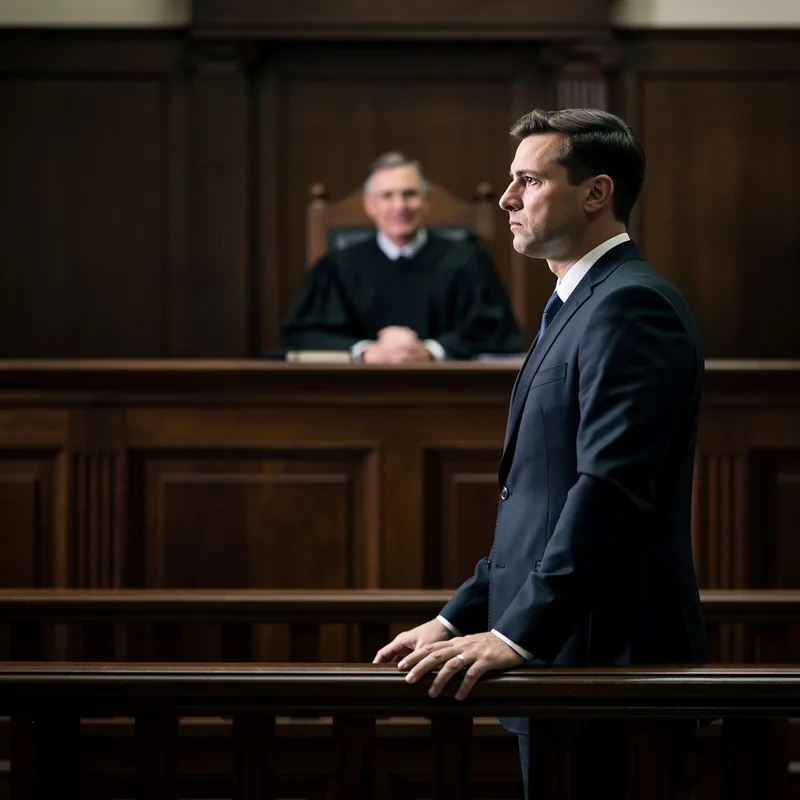
to stand trial
 60
5.5
60
5.5

- phrasal verb
- /stænd traɪəl/
- After months of waiting, the defendant will stand trial next week for the drug charges.
- stand trial for murder
- unfit to stand trial
- competent to stand trial
Loading YouTube…
Watch on YouTubeI guess that's a Now Novak stood trial, and lucky for him, the jury acquitted him.
- I guess that's a Now Novak stood trial, and lucky for him, the jury acquitted him.
- And so they demand they fire him and they say step down, come back to Rome, stand trial for your crimes.
- So at great personal and diplomatic risk, they whisked him out of Argentina, brought him back to Israel where he stood trial and then was executed.
- I get, you know, I got to stand trial for my nonsense.
- And so yeah, he stood trial in a, in a, in a wheelchair.
Examples
-
It'll be about his ability to stand trial.
-
Agreement quickly emerged that Saddam would stand trial in an Iraqi court.
Academic text (2007) -
We want him to stand trial at home.
-
Subsequently, some of them had to stand trial in a court of law.
Academic text (1991) -
We have to assess your ability to stand trial.
-
- I'm going back to Philadelphia... - and you are going to stand trial on Friday.
-
You are hereby committed to stand trial at the Central Criminal Court.
-
One of those goals was to take Noriega into custody to stand trial for the charges pending against him.
Academic text (1993) -
Carlos was finally arrested in Sudan and flown to France to stand trial in August of 1994.
Fiction book (1997) -
In 1953, Adaocha Ntu, also known as Esther Johnson, stood trial for the murder of her British lover, Mark Hall.
Academic text (2017)
Antonyms

Surface Forms
Morphology
The noun 'trial' clearly signals court proceedings, but 'stand' is used metaphorically here (meaning 'to undergo' or 'to face'), not literally 'to be upright'. Because the metaphorical role of 'stand' is somewhat predictable from context yet not a direct compositional reading, a B1 learner who knows the words could often guess the general meaning but might not be fully certain without prior exposure.
Etymology
The phrase stand trial comes from the idea that someone would literally stand in front of a judge during a trial. That's why it means 'to appear in court to be judged'.