

squinty
- adjective
- /ˈskwɪnti/
- He had, all in all, made a good decision; she was not yet squinty-eyed.
- squinty-eyed
Examples
-
For example, Caesar means hairy, while Strabo means squinty, Calvis means bold, and Esca means pointed nose.
-
"What do you mean?" he says, shooting his first look at me, squinty and challenging, "What would I be nervous about?" Then he squirms more pronouncedly; why did I say that?
Fiction book (2002) -
And I'm still very squinty at how she washes the cup when we finish this.
-
Her skin was no darker than a good tan would produce back in West Texas, but her face was just plain ordinary, with what she considered a lantern jaw and squinty little commonplace brown eyes.
Fiction book (2001) -
The pond is as round as a smiling cheek, the setting sun a blush on it like rouge, and in the sky a thin crescent moon, the squinty eye of it, the shut eye of it, has already risen, as if it just can't wait; it has things it wants to see, and it won't be kept in the dark any longer.
Fiction book (1993) -
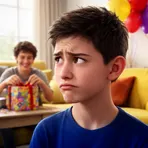
Her squinty gaze suggested she didn't trust his explanation.
-
After hearing the rumor, he shot her a squinty look filled with doubt.
-
The detective raised a squinty eyebrow at the suspect's answers.
Synonyms

 5
7.4
5
7.4

Angled toward one side, often used for looks or glances

 1
7.4
1
7.4
Looking sideways in a way that shows doubt or envy

Looking to one side in a way that shows doubt or envy

Looking to one side with doubt or suspicion

Looking to one side with doubt or suspicion
How Suspicious

Surface Forms
Morphology
Etymology
Squinty comes from the verb squint ('to look with partly closed eyes') and the ending -y ('having' or 'full of'). Think of someone giving a small, sideways look with one eye half closed — so a squinty glance feels doubtful or suspicious.