
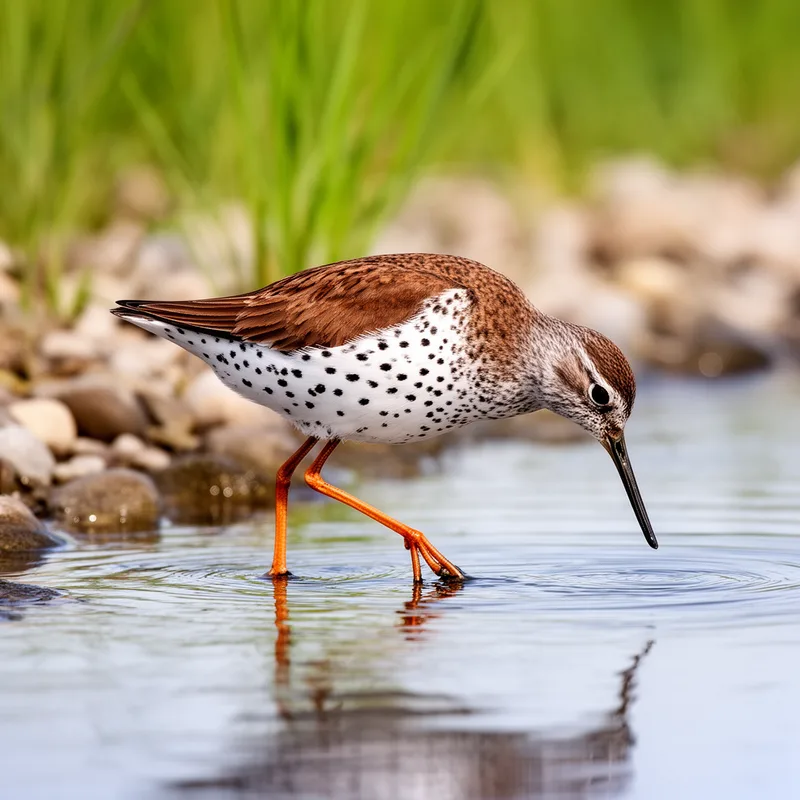
spotted sandpiper
- noun
- /ˈspɑːtɪd ˈsændˌpaɪpər/
- US
- While walking along the river, I spotted a spotted sandpiper searching for insects in the mud.
- female spotted sandpiper
Examples
-
In 1975, field biologist Steve Maxson and I headed to Little Pelican Island in Minnesota's Leech Lake to study the spotted sandpipers that bred there.
Academic text (1995) -
Unlike many other shorebird species, which nest in the Arctic, spotted sandpipers breed south of the tundra, often along rivers and on islands in large lakes.
Academic text (1995) -
The following summer, when both birds arrived on the island, they quickly mated and went on to raise healthy young spotted sandpipers.
Academic text (1995) -
But the legacy of the spotted sandpipers of Leech Lake is the wealth of natural history secrets they revealed.
Academic text (1995) -
My observations indicated that female spotted sandpipers are in control of mating.
Academic text (1995) -
Female spotted sandpipers, which arrive first at the nesting ground, essentially always pair first with older males.
Academic text (1995) -
The female spotted sandpiper left her mate sitting on their clutch of four eggs and headed into a neighboring territory on the lakeshore.
Academic text (1995) -
The spotted sandpiper is easily recognizable by its black spots against white underparts during breeding season.
-
In the spring, many spotted sandpipers return to breed in the wetlands of North America.
Synonyms

A small bird with spots that lives near rivers and lakes
Surface Forms
Morphology
The meaning is directly compositional: 'spotted' describes the appearance of the noun 'sandpiper', so a learner who knows both words can infer it is a sandpiper with spots. This kind of adjective + noun naming pattern is descriptive and cross-linguistically common, so a B1 learner would readily understand the general referent even if they lack species-specific details.
Etymology
Spotted sandpiper comes from a simple picture: spotted for the dark spots on the bird's white belly in summer, and sandpiper for a small bird that walks along sand and riverbanks. So the name means 'a small shore bird with spots'.

