
spiration
- noun
- /ˈspɪrˌeɪʃən/
- Formal
 :
spiración
:
spiración
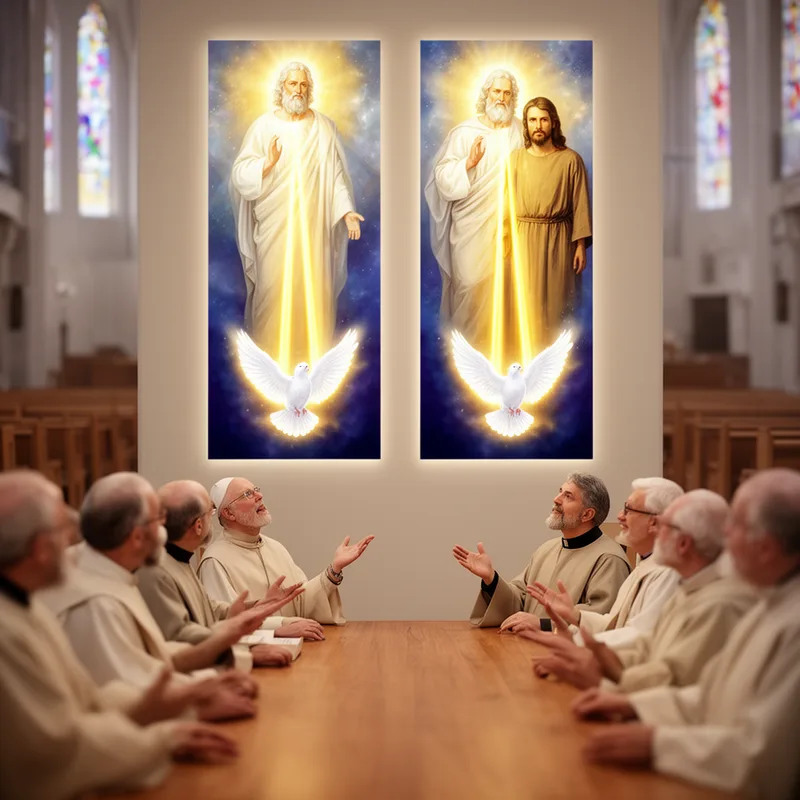
- In Christian theology, spiration refers to the belief that the Holy Spirit proceeds from the Father and the Son.
- active spiration
- passive spiration
- participation in spiration
Examples
-
It is a supernatural analogue for divine active spiration, a created participation in and imitation of the Father and the Son as the one principle from which the Holy Spirit proceeds.
Academic text (2006) -
The mission of the Spirit joins the procession of the Spirit (spiration) from the Father through the Son to a temporal effect other than a parallel incarnation, other than an assuming of any created reality into hypostatic union.
Academic text (2008) -
How can we name terms and relations in religious experience that express created participations in active and passive spiration?
Academic text (2006) -
It is a habit that is a gift from God, operating a person's participation in and imitation of divine active spiration.
Academic text (2006) -
Thus, only in the realm of the supernatural analogues of active and passive spiration do we have the data for a phenomenology of grace; and even there, only with great difficulty.
Academic text (2006) -
And since active spiration is identical to paternity and filiation considered together, the question reflects our participation in trinitarian life in toto.
Academic text (2006) -
This is particularly true for the second and third points of the hypothesis, those having to do with sanctifying grace and the habit of charity as created participations, respectively, of active and passive spiration.
Academic text (2006) -
The two processions ground four real relations, of which three are really distinct from one another; and these three are not just relations as relations, and so modes of being, but also subsistent, and so not just paternity and filiation and passive spiration, but also Father, Son, and Holy Spirit.
Academic text (2006) -
(4) that they issue from a created participation in the active spiration, the notionaliter diligere, of Father and Son, in that they are the grasp of evidence and proceeding affirmation of one who is in love with a love that participates in God's own love; and
Academic text (2006) -
The concept of spiration highlights the relationship between the Holy Spirit and the divine Trinity in Christian doctrine.
Synonyms


 1
9.9
1
9.9
How the Holy Spirit is believed to come from the Father and the Son
Surface Forms
Morphology
spiration = respire (opaque) = spir + ation
Although historically related to 'breathe', this sense is a specialized theological usage (doctrine of the Spirit's procession) not predictable from the literal meaning 'act of breathing'.
Etymology
Spiration comes from the Latin root spirare, meaning 'to breathe', and it is the same root behind spirit. In Christian belief the idea is like 'breath' moving from the Father (or from the Father and the Son) to the Holy Spirit, so spiration means the Spirit's 'coming from' another member of the Trinity.