
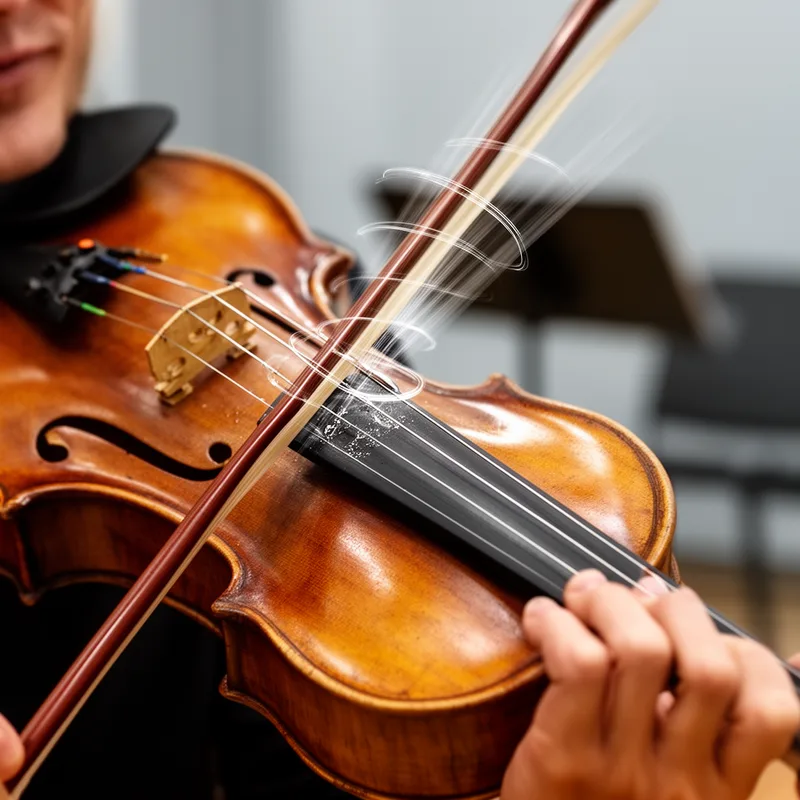
spiccato bowing
- noun
- /spɪˈkɑːtoʊ ˈboʊɪŋ/
- Specialized
- In this passage, the composer marks spiccato bowing to achieve a crisp, articulate sound.
Examples
-
Learning spiccato bowing can be challenging for beginner string players.
-
The violinist performed a piece using spiccato bowing.
-
The violinist used spiccato bowing to create a lively, bouncing rhythm in the scherzo.
-
Can you demonstrate spiccato bowing for us?
-
The violinist showcased her skill by using spiccato bowing to unleash a flurry of rapid notes.
-
In her performance, she incorporated spiccato bowing to create a lively and playful rhythm.
-
To achieve a light and bouncy sound, he practiced spiccato bowing during the rehearsal.
Synonyms


 1
9.9
1
9.9
A way of playing a violin or cello where the bow lightly bounces to make short separate notes
How Detached
- Specialized

- Specialized
Surface Forms
Morphology
The phrase is compositionally built: 'spiccato' names a detached/bouncing bowing technique and 'bowing' denotes the use of the bow, so together they denote a type of bowing that produces short, detached, bouncing notes. Although 'spiccato' is a technical/Italian term, if a B1 learner knows both constituent meanings the overall sense is directly derivable and not idiomatic.
Etymology
Spiccato bowing comes from the Italian word spiccato, meaning 'detached' or 'lifted off', and bowing is how you use the bow on the strings. Imagine the bow making small, light jumps off the strings so each note is short and separate; that's why the phrase means 'short, bouncing bow strokes'.