
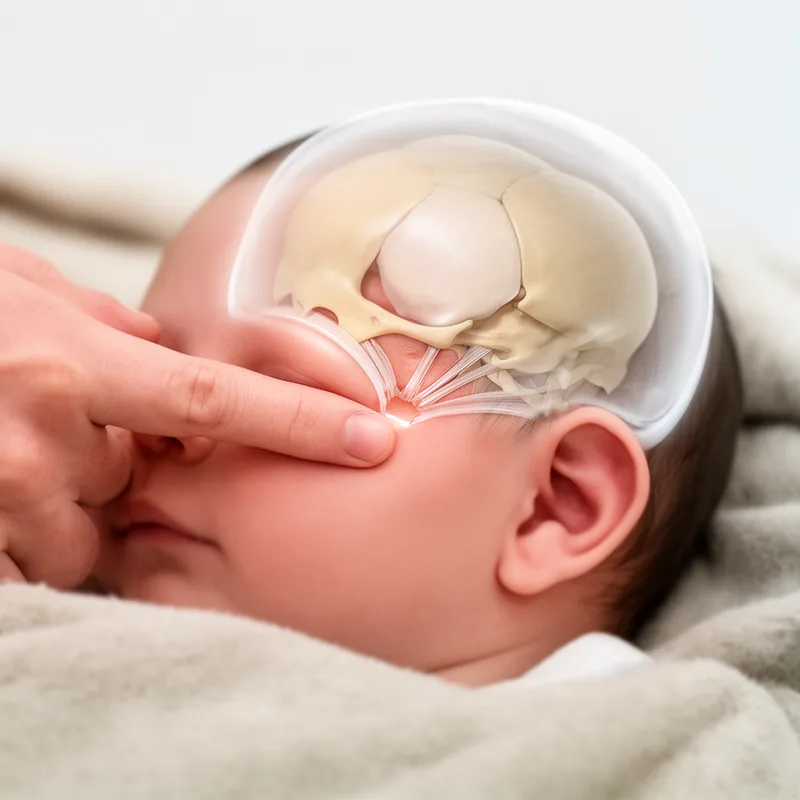
sphenoidal fontanel
- noun
- /ˌsfɪnɔɪdəl ˈfɒntənɛl/
- Specialized
- During development, the sphenoidal fontanel gradually ossifies to become the pterion.
Examples
-
The doctor checked the infant's sphenoidal fontanel for signs of premature closure.
-
Palpation of the sphenoidal fontanel can help identify certain cranial abnormalities in newborns.
-
The sphenoidal fontanel is an important feature in infant skull anatomy.
-
During a check-up, the doctor examined the baby's sphenoidal fontanel.
-
The doctor checked the infant's sphenoidal fontanel for signs of premature closure.
-
Palpation of the sphenoidal fontanel can help identify certain cranial abnormalities in newborns.
-
During a check-up, the doctor examined the baby's sphenoidal fontanel.
Synonyms

 2
9.2
2
9.2

A soft spot on a baby's head where the skull bones do not yet meet
 2
6.1
2
6.1
A soft area on a baby's head where the skull bones have not joined


 1
9.6
1
9.6
A soft spot on a baby's head where the skull bones are not yet joined

A soft spot on the side of a baby's head where skull bones meet

The soft spot on the side of a baby's head where several skull bones meet
Surface Forms
Morphology
sphenoidal + fontanel
The phrase combines an adjective meaning 'relating to the sphenoid (bone)' with 'fontanel' meaning a membrane-covered gap in an infant skull, so the compound denotes the fontanel located by the sphenoid region; this meaning is directly derivable from the parts. Although technical anatomical vocabulary is rare, the adjective+noun composition is regular and therefore predictable to a learner who knows both constituents.
Etymology
Sphenoidal fontanel is the soft spot on a baby's head; sphenoidal points to the nearby sphenoid bone and fontanel means a 'soft spot'. The name comes from this literal soft gap between skull bones, and when the bones grow together the gap closes. That's why the term means 'the soft gap in an infant's skull'.